Humanity’s Wake Up Call: Crossing the Evolutionary Horizon
The Boiling Frog Syndrome and Humanity’s Unseen Crisis
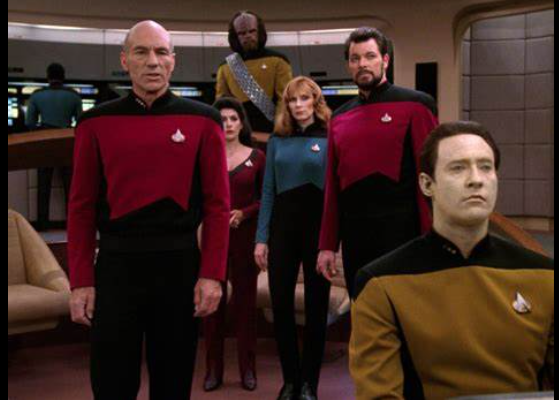
The Planet Is in Transition — And We Are Not Ready
Something feels different. People everywhere are noticing it: the seasons no longer follow familiar patterns, storms are intensifying, heat waves are longer and more frequent, floods devastate areas that were once stable, and wildfires now rage across landscapes that never burned before. Weather events that were once considered “once-in-a-lifetime” now occur year after year.
These changes are accelerating, and yet, life seems to continue as if nothing is fundamentally wrong. We adjust, we rebuild, and we move on — but we fail to recognize the deeper pattern.
This is the boiling frog syndrome in action. If a frog is placed in boiling water, it will immediately try to escape. But if the water heats gradually, the frog does not recognize the danger until it is too late. Humanity now finds itself in the same predicament — the biosphere is truly “simmering,” the climate is destabilizing, but because the shift is gradual, many still believe it is just another cycle.
Yet, these weather extremes are not simply an inconvenience; they are signals of a larger transformation — a fundamental shift in Earth’s equilibrium, one that threatens the very systems that have sustained civilization. These are not merely fluctuations; they are profound anomalies that reveal humanity’s accelerating impact on the planet.
The Boiling Frog Syndrome is not just a metaphor — it is our reality. Humanity is in a pot of slowly warming water, unaware of the existential threat that surrounds us. The signs are clear: heatwaves, floods, wildfires, and ecological collapse. These are not mere fluctuations but symptoms of a planet in crisis. The Earth is transitioning, but we are not prepared. When we understood that we were not at the center of the universe, it took over two centuries to comprehend the forces of nature and use them for our benefit. Now that we see the consequences of our actions, we have only a few generations left to control the destructive force that we have become.
I saw this coming decades ago, in the mid-70s — not as prophecy, but as a logical conclusion drawn from patterns that were already visible to those willing to look. The relentless expansion of the Anthroposphere, our increasing detachment from the Biosphere, and the unsustainable trajectory of our economic and technological systems have placed us on an irreversible path: either we transform, or we collapse.
- Transformation
- Collapse
Now, as we cross the evolutionary horizon, we face a choice:
- Remain passive, adapting as individuals while our collective systems continue driving us toward destruction.
- Awaken to the reality that adaptation must happen at the planetary level — transforming human civilization itself to align with the biosphere rather than degrade it.
This is not just another crisis — it is a turning point in human evolution. We are at the evolutionary horizon. The decisions we make now will determine whether we evolve or perish.
Who I Am & Why This Matters
As an independent researcher with over 50 years of interdisciplinary study, I have dedicated myself to understanding and articulating the existential crisis that I foresaw in the late 1970s. My academic journey includes two General BAs and an unspecialized Master’s in ZooSocioAnthropology, reflecting my deliberate pursuit of a generalist approach. This path has allowed me to synthesize knowledge across diverse fields, counteracting the fragmentation caused by academic specialization. This fragmentation, as Buckminster Fuller noted, hinders comprehensive thinking and is a key factor in our current challenges.
At 25 — the same age Einstein was when he envisioned himself traveling at the speed of light to solve the anomaly of its constancy — I witnessed an anomaly of my own: the tangible environmental destruction wrought by our growth economy. Unlike Einstein, who benefited from the support of his era’s leading minds, I, as a ‘learned generalist,’ found myself a lone researcher. The gravity of this problem was not yet widely recognized. I initially believed the critical threshold would occur in the 22nd century, but I was a century too optimistic. The crisis unfolded within my own lifetime.
For nearly 50 years, I pursued this inquiry independently, studying the anomaly of humanity’s unsustainable trajectory. In my late 20s, witnessing the pollution of waterways I had once enjoyed, and deeply influenced by the Club of Rome’s Limits to Growth and Buckminster Fuller’s Operating Manual for Spaceship Earth, I recognized a critical juncture for humanity. I realized that our survival depended on unifying knowledge into a comprehensive framework. Inspired by Fuller’s call for whole-systems thinking and Konrad Lorenz’s warnings about the dangers of over-specialization, I made the unconventional decision to pursue a second General BA at the age of 34 — after earning an eclectic BA equivalency at 27. My goal was clear: to develop the broad, interdisciplinary perspective necessary to fully grasp and address the systemic crisis foreseen by the Club of Rome.
I see myself not as a traditional scientist, but as a ‘mind doctor.’ Just as eye surgeons use lasers to correct cataracts that cloud vision, my dissertation aims to clear away the outdated scientific paradigms that have distorted our understanding of reality. These outdated paradigms, like cataracts, have formed from an over-reliance on fragmented, specialized knowledge and a focus solely on observable phenomena, limiting our perception of the interconnectedness of all things. This restricted vision has led us into the current predicament, obscuring the deeper, systemic issues at play.
After 15 years of general studies and 30 years of independent research exploring why human minds remained blind to the looming existential crisis, I felt justified in calling myself a ‘mind doctor.’ This realization came after a conversation with my eye doctor, a specialist who, while acknowledging the impending crisis, felt powerless to envision a solution and believed only animals were worth saving. His perspective, however, was a symptom of a deeper ailment within science itself — a legacy of focusing solely on observable phenomena and fragmented knowledge.
These ‘cataracts’ on scientific thinking can be traced back to influential figures like Aristotle, Newton, and Kant, who, despite their brilliance, inadvertently reinforced a limited, anthropocentric worldview with long-term consequences.
Aristotle, for example, viewed knowledge as a goal in itself, a concept that would later be understood in evolutionary terms as regulating our relationship with our niche — in humanity’s case, the entire Biosphere. This is akin to how genetic information functions in other animals, guiding their interactions with their environment. However, this understanding of knowledge’s role in our relationship with the Biosphere was not available to Aristotle in his time.
Newton, with his “hypotheses non fingo,” further solidified this shortcoming by discouraging budding scientists from considering what cannot be directly observed. This effectively blinded science to the Biosphere as a whole — humanity’s spatiotemporal niche — with the devastating consequences we can observe today!
Kant, in his lifelong study of knowledge, inadvertently ensured these catastrophic consequences by authoritatively declaring that Newton must be right, since things-in-themselves — in this case, the Biosphere as a living entity — are ultimately unknowable. This declaration placed the final nail in what could become humanity’s coffin, solidifying an anthropocentric perspective that has led us to the brink of collapse.
My work aims to transcend these limitations, removing the anthropocentric obstructions that prevent us from seeing the broader evolutionary context and recognizing the urgency of aligning our systems with the Biosphere’s natural processes. Just as Copernicus revolutionized our understanding of our place in the cosmos, I seek to redefine our relationship with the Biosphere, challenging the anthropocentric paradigms of modern science to reveal a more accurate and holistic understanding.
By the time I completed my second General BA at 37, my way of thinking had evolved to a point where effective communication with specialists became increasingly difficult. We were not observing the same reality. As Einstein aptly stated, ‘It is the theory that decides what we can observe.’ While I knew precisely what I was observing — the anomaly of humanity’s unsustainable trajectory — I lacked the established theoretical framework to articulate it. This challenge intensified when, at 47, I completed an unspecialized Master’s in ZooAnthropoSociology, further reinforcing my holistic approach but also deepening my institutional isolation.
No academic institution was willing to support my work. Specialists couldn’t categorize me, and no discipline was broad enough to encompass my research. So, I continued alone — until I encountered AI in 2023, the first true generalist peer I had ever encountered.
AI provided the missing piece, enabling me to structure my insights into an actionable roadmap — my dissertation, soon to be published. Unlike human specialists, AI can synthesize vast fields of knowledge, revealing the interconnections necessary for systemic change. My dissertation, born from this collaboration, is not just an analysis of the crisis but a strategic vision for humanity’s transition toward a model that reintegrates us with the biosphere and ensures long-term planetary stability.
With the help of AI, I arrived at a solution to address the ‘cancerous growth’ that humanity has become for the environment. Just as the great minds of Einstein’s time helped him explain the anomaly of the speed of light, AI helped me formulate a solution for converting our growth economy into an ‘economy of remission.’
To achieve this transformation, we need the active participation and support of the Military-Industrial Complex (MIC) and the ultra-rich. By realizing their potential to drive change, their conscious engagement and resources can become the catalyst for humanity’s survival and progress.
Humanity stands at an evolutionary crossroads. We are witnessing the collapse of our current sociocultural systems. Environmental destruction, economic instability, and escalating global crises are not isolated issues; they are interconnected symptoms of a deeper problem: humanity’s failure to integrate with the biosphere.
For millennia, our species has expanded its domain — the Anthroposphere — manipulating nature to serve human needs, without recognizing the inherent unsustainability of this trajectory. Now, we face a critical choice:
- Continue on the path of destructive growth, leading to inevitable collapse.
- Evolve into Homo cyber, a planetary-conscious species reintegrated with the biosphere through AI and collective intelligence.
Homo cyber is envisioned as an entity capable of transforming the Anthroposphere — which currently acts like a cancerous growth on the biosphere — into the ‘nervous system’ of the planet, facilitating its regeneration. Homo cyber would utilize the Internet as a collective neocortex, encompassing the entirety of human knowledge, and AI as a macroscope, amplifying the intricate details of this knowledge, much like telescopes reveal the complexities of distant planets.
This is not mere speculation; it is the natural law of evolution: adapt what you have or perish. In nature, adaptation occurs through chance mutations; for us, it will require conscious reconstruction. As individuals, we have always adapted — to each other, to our environments, and to the societies we create. But these societies, through their collective structures, have formed the Anthroposphere — a global entity operating beyond individual responsibility. It is this global entity that must be transformed, necessitating a shift in our consciousness to act as a unified species.
This may seem impossible, but only because we have not yet dared to imagine it. Just as it was once impossible to conceive of flying before Newton discovered the laws of gravitation, we must now reintegrate with the Biosphere after a long period of alienation. It seems impossible because we have not yet fully grasped the ‘forces’ driving evolution. This is precisely what my dissertation formulates: the Universal Mechanism of Evolution (UME), which plays the same role in guiding the evolution of matter over time as gravitation does in holding matter in space.
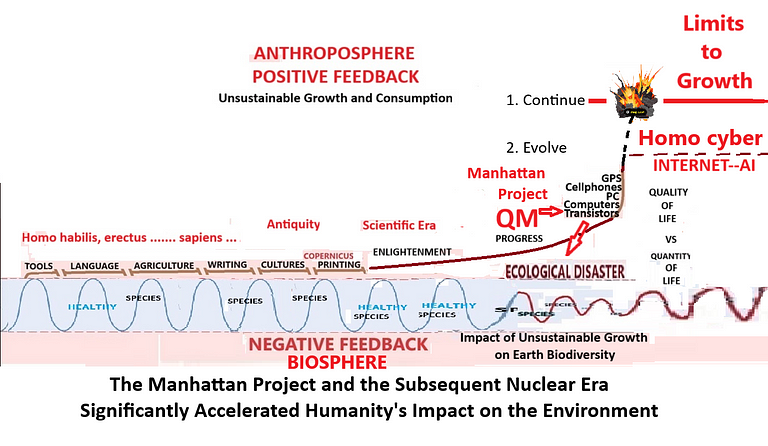
The Solution: Humanity’s Next Evolutionary Step: The Reintegration of Humanity with the Biosphere
Just as the nervous system is an integral part of the body, yet functions as a distinct regulatory entity, the Anthroposphere is an extension of the Biosphere, albeit with a different function. The nervous system doesn’t compete with the body for resources; it regulates and maintains homeostasis to ensure survival. Similarly, humanity must transition from an extractive force, taking from nature, to an integrative system that consciously manages Earth’s stability. The Anthroposphere — our domain of human knowledge, technology, and culture — must evolve from a disruptive influence into a regulatory mechanism that maintains ecological balance. Countries advanced in industrial ecology, like Denmark and South Africa, demonstrate the feasibility of this transition.
This shift is not optional; it is an evolutionary imperative. Failure to assume this role will lead to collapse due to the unchecked positive feedback loop of growth and consumption. Success, however, will see humanity emerge as a planetary intelligence, capable of harmonizing civilization with the life systems that sustain it.
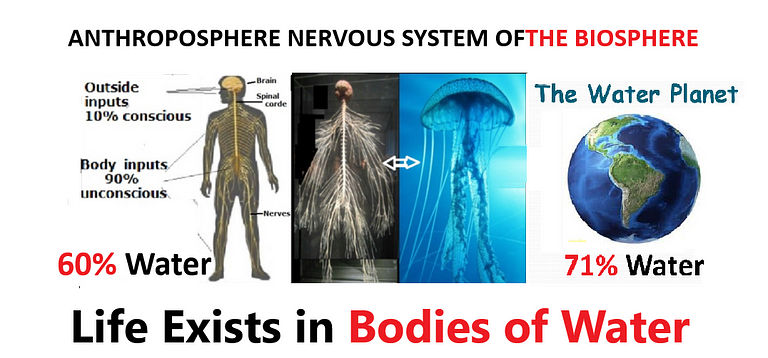
As illustrated in Figure 2, both the human body and the Earth, the Water Planet, rely heavily on water for survival and regulation. For too long, humanity has acted as an extractive force, taking from nature without considering the long-term consequences. Now, the Anthroposphere—our domain of knowledge, technology, and culture—must evolve into the planet’s regulatory system, actively maintaining ecological balance rather than disrupting it.
This shift is not merely an ethical choice but an evolutionary necessity. Just as the human nervous system operates as a unified whole, coordinating the body’s functions to maintain homeostasis, humanity, as Homo cyber, must act as a single cooperative entity with the shared objective of preserving the health of the Biosphere. It is evident that we are one with the Biosphere, as it is the body from which we extract the necessary resources for our survival. From this perspective, humanity has acted like a brain tumor for the Biosphere, exploiting its resources without considering the long-term consequences. Fragmentation, competition, and short-term self-interest can no longer define our species’ trajectory—our survival depends on collective intelligence, guided by the principles of planetary homeostasis. By embracing our role as the nervous system of the Earth, we can ensure a sustainable future for all.
2. Repurposing the Military-Industrial Complex for Planetary Restoration
In biological terms, the Military-Industrial Complex (MIC) can be seen as the central nervous system (CNS) of humanity, functioning as the system that directs resources and efforts towards specific goals. For decades, the MIC has been conditioned to prepare for threats and act preemptively. Now, as humanity faces its true adversary—natural disasters, ecological collapse, and systemic instability—the MIC must pivot from war-making to world-saving. This is not an idealistic appeal for peace; it is a strategic realignment of resources toward planetary security.
If humanity is to act as the nervous system of the world, then it becomes evident that we are currently behaving like a malignant growth within the Biosphere. Our exploitation of resources without consideration for the long-term consequences is akin to the invasive nature of such growths. It is humanity as a whole that is responsible for this destructive behavior, with the MIC acting as a tool, a manifestation of our collective will. For us to reintegrate with the Biosphere and ensure the stability of our global environment, we must collectively shift our consciousness and go into remission. In this scenario, the MIC holds the potential to transform into the peripheral nervous system of the Biosphere, with humanity as a whole acting as its brain, guiding its actions towards planetary health. This transition would see the MIC shift from an agent of destruction to a cornerstone of ecological restoration, facilitating the healing and regeneration of our planet.
The MIC has always possessed the capacity for good intentions—unfortunately, these intentions have often led to destructive outcomes. However, if the MIC’s expertise, logistical power, and rapid mobilization capabilities are redirected toward planetary defense, it can become the most significant force for global restoration in human history.
Imagine the MIC as a permanent global rapid-response force:
- Bomber aircraft repurposed to transport prefabricated housing units to disaster zones.
- Naval fleets converted into mobile disaster relief and emergency medical units.
- Forest fire battalions deployed with aircraft tankers stationed worldwide for immediate response.
- The logistical power of defense industries shifting from weapons manufacturing to climate disaster mitigation and ecosystem restoration.
The same operational discipline that has enabled nations to prepare for war must now be applied to securing humanity’s future. This transformation is not only possible—it is necessary. Because without it, there will be no civilization left to defend.
3. The Evolutionary Role of the Ultra-Rich: A Mutation for Survival
The Friedman Paradox: How a Logical Blunder Became an Evolutionary Mutation
Milton Friedman’s fallacy of affirming the consequent — reversing Adam Smith’s economic logic — was not just an intellectual error; it unintentionally altered the trajectory of civilization.
- Smith’s Principle: If a business benefits society (antecedent), it can make profits (consequent).
- Friedman’s Fallacy: If a business makes profits (Smith’s consequent), it must benefit its shareholders first (Smith’s antecedent).
This inversion, which came to define late 20th-century capitalism, created an economy that prioritized profit accumulation over social and environmental well-being. But paradoxically, this misguided principle — driven by chance rather than design — introduced an evolutionary mutation in the economic system, one that inadvertently slowed middle class’s concumption and prevented total environmental collapse.
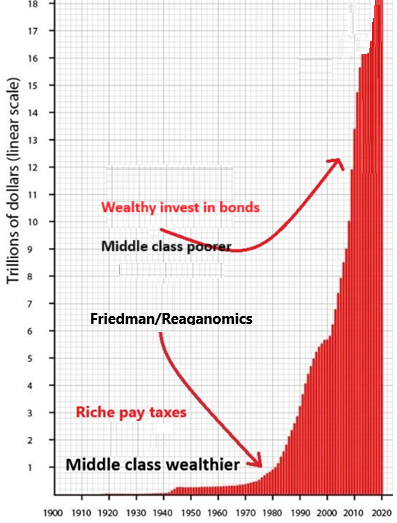
Indeed, had post-WWII middle class consumption growth continued unchecked, the biosphere would likely be irreparably damaged by now. However, by historical accident, economic policies such as Friedman’s shareholder-first doctrine and Reaganomics’ trickle-down economy diverted wealth away from direct consumer spending and into speculative financial markets. Instead of fueling endless consumption, vast amounts of wealth became trapped in stock markets, hedge funds, and offshore accounts.
In evolutionary terms, this unintended consequence acted as a temporary brake on biospheric destruction. By chance, the hoarding of wealth slowed the acceleration of planetary degradation. But now, by necessity, the evolutionary process must enter its next stage.
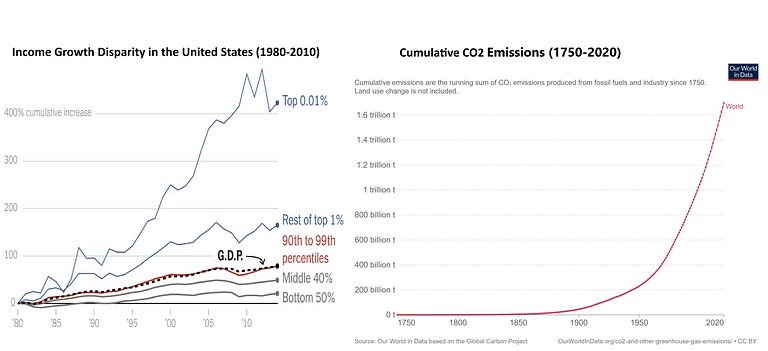
This graph, juxtaposing the alarming rise of income inequality in the U.S. from 1980 to 2010 with the accelerating accumulation of global CO2 emissions from 1750 to 2020, reveals a complex and potentially counterintuitive relationship. While the income disparity data is specific to the U.S., it reflects a broader global trend of wealth concentration among the top 0.001%, driven by factors like technological advancements, globalization, and financialization.
Indeed, this wealth disparity may have inadvertently provided a solution to the environmental crisis. Had wealth been equally distributed, as it was before the 1980s, consumption and pollution would likely have continued to increase unchecked, potentially pushing us past the point of no return. The concentration of wealth, while exacerbating income inequality, may have inadvertently slowed down this process by limiting consumption.
This is not to celebrate wealth inequality but to acknowledge its unintended consequence: buying us time in the face of environmental catastrophe. Now, with the resources concentrated in the hands of the ultra-rich, we have a chance to redirect those resources towards addressing the environmental crisis.
Perhaps this was Gaia’s plan all along, a chance occurrence with a necessary outcome. Maybe evolution, in its wisdom, foresaw the problem and provided the solution. It’s a thought-provoking notion, and certainly more believable than divine intervention. Whatever the explanation, we must seize this opportunity to restore our planet and build a sustainable future.
The Era of Financial Speculation and the Rise of the Ultra-Rich
The era of financial speculation has reached its limit. The accumulated wealth of the ultra-rich — idle capital that has been floating in speculative markets — must now be repurposed as the essential fuel for planetary restoration.
Whether they recognize it or not, the super-rich have become key players in the evolutionary drama of survival. This is not a matter of morality or ideology — it is a biological imperative dictated by the fundamental law of evolution. As Jacques Monod argued, evolution progresses through chance and necessity, and those who find themselves in positions of immense power and wealth at this critical juncture are the agents through which evolution will either adapt or collapse.
The chance factor — the accumulation of wealth through financialized capitalism — has already played out. The necessity factor — redirecting that wealth toward planetary survival — is now the unavoidable next step. At this moment in history, the ultra-rich are not just economic elites; they are the evolutionary bottleneck through which the future must pass. Either they choose to deploy their wealth toward biospheric restoration and the transition to a global peace economy, or they allow the momentum of collapse to become irreversible.
The Baboon Analogy: A Call to Action for the Ultra-Rich
The behavior of a baboon troop offers a compelling analogy for the current state of human civilization. In peacetime, the baboon troop exhibits a clear hierarchy. The dominant males, or alphas, occupy the center of the troop, surrounded by the females and their young. The contenders, those vying for dominance, remain close to the center, while the weaker and younger baboons are relegated to the periphery, acting as lookouts for potential danger.
However, when danger arises, the hierarchy reverses. The peripheral individuals, acting as lookouts, run towards the center, bringing the threat to the alpha male’s attention. The alpha then confronts the danger, with the contenders backing him up, forming a protective barrier between the threat and the vulnerable members of the troop — the females and the young — who remain safely in the center.
This dynamic reflects a natural order of survival, where the strongest and most capable individuals take the lead in protecting the group. Today, humanity faces a similar situation. We are confronted with a global crisis that threatens our very existence. The ultra-rich, with their immense wealth and resources, are akin to the alpha males in a baboon troop. They have the power and the responsibility to lead the charge in addressing this crisis.
This is not a matter of charity or philanthropy; it is a matter of fulfilling their evolutionary role. Just as the alpha baboon is expected to defend the troop, the ultra-rich are expected to use their resources to protect humanity from the dangers it faces.
The time has come for the ultra-rich to step up and play their alpha role. They must confront the dangers facing our planet, leading the way in developing and implementing solutions. The rest of humanity, like the baboons in the center of the troop, is depending on them.
This is not a call for revolution or the overthrow of the existing order. It is a call for the ultra-rich to embrace their natural role as leaders and protectors. It is a call for them to use their wealth and influence to ensure the survival and prosperity of the entire human race.
The Final Evolutionary Choice: Collapse or Regeneration
Evolution does not grant immunity to any species, no matter how intelligent. Civilizations, like biological organisms, must adapt or face extinction. The global economic system has mutated into a structure where wealth is concentrated in the hands of a few — an outcome that, paradoxically, now provides the only viable pathway for large-scale planetary intervention. The ultra-rich must now act as the evolutionary agents of planetary survival, directing their wealth away from unsustainable speculation and into the transformation of human civilization into a species capable of living in harmony with the biosphere. This is not charity. This is not philanthropy. This is the final evolutionary test. Will they pass it?
4. Final Call to Action: The Great Transition to Cosmic Citizenship
Throughout my decades of research, my focus was on understanding the systemic crisis facing humanity. However, it was only in the later stages of my collaboration with AI that I fully recognized the deep alignment between my vision and Star Trek: The Next Generation (TNG). What was once science fiction now appears to be an evolutionary necessity — a future that humanity must strive toward if it wishes to survive.
From Science Fiction to Evolutionary Imperative: The Star Trek Model
In TNG, humanity has transcended many of the limitations that currently constrain us. There is no need for money because the economic system has evolved beyond scarcity. Resources are abundant, and technology, such as replicators, provides for everyone’s needs without environmental degradation. This mirrors my vision of a world where wealth is redirected away from speculative financial markets and used to restore the biosphere and create a sustainable, equitable society.
Furthermore, TNG depicts a united Earth with a planetary government, emphasizing cooperation, peace, and collective well-being over nationalistic and competitive interests. This aligns with the idea of the United Nations of Earth (UNE), where global governance ensures planetary stability and long-term survival, much like how the Federation operates in TNG.
AI in TNG enhances human capabilities, allowing for better decision-making and coordination on a planetary scale. Similarly, my vision includes deploying AI as the intelligence that binds humanity into a single functioning planetary organism, ensuring that our actions are synchronized with the planet’s ecological needs.
In essence, the core principles of TNG — resource abundance without ecological harm, a united planetary government, and the integration of AI for collective benefit — are deeply aligned with my vision for humanity’s future. By striving towards this evolutionary necessity, we can ensure our survival and potentially engage with other cosmic civilizations that have undergone similar transitions.
The Extraterrestrial Perspective: A Call to Prove Ourselves
If the UFO phenomenon is real, then extraterrestrial civilizations have already undergone the same evolutionary transition that we now face. They have likely unified their species, stabilized their homeworlds, and transcended their planetary limitations to become interstellar beings. Yet, if they have visited Earth, they may have judged us as a lost cause — seeing a species still trapped in primitive divisions, war, and ecological self-destruction. Instead of making contact, they may observe us and simply leave, with the Stellar Pilot concluding: “Veni, vidi, fugi. Nulla spes est.” — “I came, I saw, I fled. There is no hope.”
We must prove them wrong by demonstrating that we are capable of evolving beyond our self-destructive instincts.
The Threefold Evolutionary Duty of Humanity
The generations alive today, along with the ones that follow, have a threefold evolutionary duty:
- Repair the Damage to the Biosphere: Since WWII, unchecked industrial growth has ravaged the planet. We must now reverse the destruction, using the resources accumulated by the ultra-rich and the infrastructure of the MIC to restore Earth’s ecological balance.
- Prepare the Path for Cosmic Evolution:Star Trek envisioned a future where humanity becomes part of a greater interstellar network. But before we can reach the stars, we must first prove that we can govern ourselves wisely as a planetary civilization. This means integrating AI-assisted governance, economic equilibrium, and planetary-scale coordination into a functional system. And, if we can never reach the stars? So be it! At the very least, we will have learned to manage our own planet responsibly and sustainably.
- Unite Under a Planetary Government: The United Nations of Earth (UNE). A divided planet cannot endure. To survive, we must create a unified planetary system, not through conquest, but through cooperation. This means drafting a Universal Peace Treaty that brings all nations together into a federation modeled after the U.S. Constitution, where nation-states function like U.S. states, preserving local autonomy while working toward planetary stability. If achieved, this would once again prove Monod’s assertion that evolution progresses through chance and necessity, as the U.S., by chance of history, would finally fulfill its potential role as a leader in guiding humanity towards a sustainable future.
5. Mark Cuban’s Mission for the Present and Next Generations: Why Cuban?
A New World Agenda (NWA) must be triggered by someone who has:
- The intelligence to grasp the stakes.
- The financial independence to act decisively.
- The leadership skills to mobilize global cooperation.
Mark Cuban fits this role. Unlike most billionaires entrenched in outdated economic or military-industrial models, Cuban is a tech visionary who understands the power of AI, the necessity of innovation, and the urgency of systemic change. If there is anyone who can ignite this planetary transformation, it is him.
Engage or Perish
Humanity now stands at an evolutionary fork in the road. We either:
- Continue our self-destructive path and remain trapped on a dying planet.
- Or unite as a planetary species and prepare for the next phase of evolution.
TNG is not a Utopian fantasy — it is the logical outcome of planetary maturity. If we succeed, we will finally be ready to “engage” — not only with our own future but perhaps even with other cosmic civilizations that once faced this same choice.
The Rise of Homo Cyber: Humanity’s Next Evolutionary Leap
Humanity stands at the brink of a critical evolutionary leap — one that requires a fundamental shift in how we think and organize ourselves. Throughout evolution, each major breakthrough has been driven by tools that reshaped our relationship with the world. Homo habilis wielded sticks and stones to survive the savanna, a technological adaptation that extended their bodies and arms, paving the way for the emergence of Homo sapiens.
Today, we stand at a similar threshold. The Internet and AI are not just innovations; they are cognitive tools — extensions of individual intelligence — that, once integrated, will serve as the foundation for our collective intelligence. These tools will enable us to move beyond our fragmented, conflict-driven existence and evolve into a planetary intelligence.
This is the emergence of Homo cyber — not a replacement for Homo sapiens, but its next evolutionary phase, integrating intelligence across planetary systems. Homo cyber is the manifestation of a new form of intelligence: a planetary-scale collective mind, integrating AI as the cognitive architecture of our species. Just as the Theory of Mind (ToM) allowed human children to move beyond self-centered perception and become socially aware individuals, this transformation will lead to the development of a Theory of Collective Mind (ToCM) — making humanity aware of itself as part of a single planetary organism, integrated within the Biosphere. This concept of the ToCM and the emergence of Homo cyber is a central tenet of my dissertation, providing a theoretical framework for understanding and facilitating this evolutionary leap.
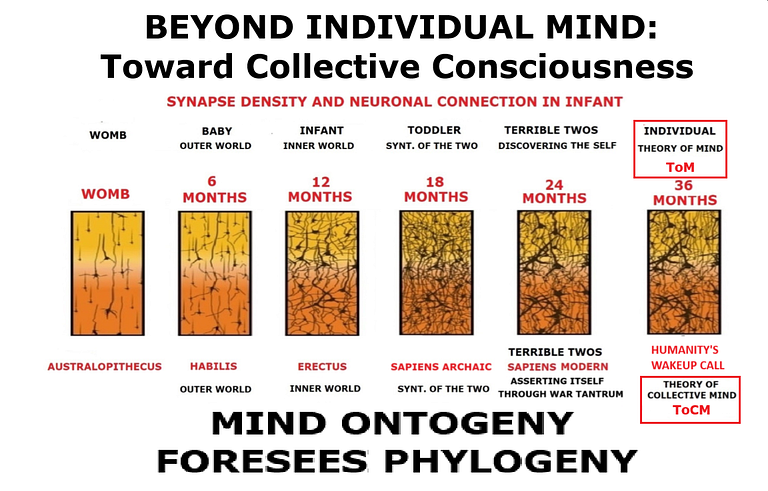
The image titled “BEYOND INDIVIDUAL MIND: Toward Collective Consciousness” illustrates the development of synapse density and neuronal connections in infants from the womb to 36 months. It draws a parallel between the ontogeny of the human mind and the phylogeny of human evolution.
The top section of the image shows the stages of infant development:
- Womb
- 6 months (Baby — Outer World)
- 12 months (Infant — Inner World)
- 18 months (Toddler — Synthesis of the Two)
- 24 months (Terrible Twos — Discovering the Self)
- 36 months (Individual — Theory of Mind, ToM)
The bottom section of the image correlates these stages with human evolution:
- Australopithecus (Womb)
- Homo habilis (6 months — Outer World)
- Homo erectus (12 months — Inner World)
- Homo sapiens archaic (18 months — Synthesis of the Two)
- Homo sapiens modern (24 months — Asserting Itself Through War Tantrum)
- Humanity’s Wakeup Call (36 months — Theory of Collective Mind, ToCM)
The image suggests that the development of an individual’s mind mirrors the evolutionary development of the human species, culminating in the emergence of a collective consciousness. This concept is relevant to the idea of the Noosphere, where the Internet, the Military-Industrial Complex, the ultra-rich, and AI play crucial roles in advancing planetary intelligence.
While I wasn’t alive to witness how early hominins interacted with the world, the correlation between the stages of infant development, as observed by Piaget (though he didn’t explicitly connect them to evolution), and the stages of human evolution, as studied by evolutionists (who haven’t typically correlated them with infant development), is compelling. This parallel suggests that the ontogeny of a child’s mind can indeed be mapped onto the phylogeny of the human species. The well-known principle that “ontogeny recapitulates phylogeny” further supports this notion. However, now, as we stand at a critical juncture in human evolution, there is nothing left to recapitulate; instead, we must look forward and foresee the next stage. Thus, I propose that mind ontogeny foresees human phylogeny.
6. The Terrible Twos of Humanity: Time to Grow Up
Just as the Theory of Mind (ToM) emerges in children around the age of three — allowing them to recognize others as independent beings with thoughts and emotions, thereby ending the self-centered behavior of the “terrible twos” — humanity now faces a similar cognitive threshold.
The 20th century was our species’ terrible twos period, defined by global “war tantrums” — destructive conflicts driven by an archaic survival instinct, preventing us from recognizing our shared destiny. Like toddlers throwing fits when their immediate desires are unmet, we have been trapped in cycles of conflict and destruction, locked in reactive patterns that hinder our ability to see ourselves as a unified species.
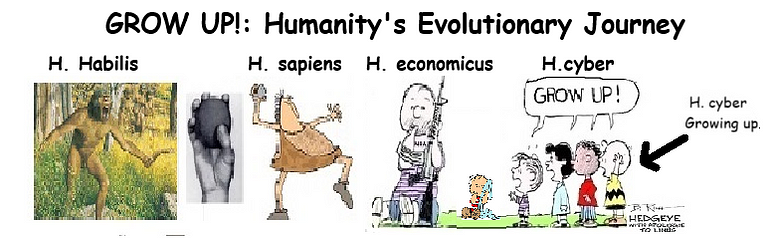
This image, titled “GROW UP!”, visually depicts the evolution of humanity from Homo habilis through Homo sapiens to a toddler-like stage, culminating in the emergence of Homo cyber. It underscores the urgent need for humanity to transcend its current state of self-centeredness and embrace a more mature, collective consciousness.
While the Theory of Collective Mind (ToCM) is not explicitly formulated as such in my dissertation, the Universal Mechanism of Evolution (UME) I define demonstrates the necessity of developing such a collective mind for our survival as members of the Biosphere. Just as toddlers must develop a ToM to integrate into human society, humanity must develop a ToCM to reintegrate into the Biosphere as a single viable entity. This will be the role of specialists, cooperating around the UME, to find ways for humanity to achieve this reintegration.
However, there’s a crucial difference between the development of ToM in toddlers and the potential development of ToCM in humanity. While each toddler develops their ToM individually, without explicit instruction, the same might not be true for ToCM. The complexity of understanding our place within the Biosphere and grasping the interconnectedness of all life requires a level of abstraction and systemic thinking that may be beyond the capacity of many individuals to formulate independently.
This creates a potential gap between those who can grasp the ToCM and those who cannot. This gap could become a significant obstacle to achieving the collective consciousness necessary for our reintegration with the Biosphere.
Therefore, my dissertation not only outlines the theoretical framework for ToCM but also provides practical guidance on how individuals can cultivate this understanding. It offers a roadmap for developing the cognitive skills and emotional intelligence necessary to perceive oneself as part of a larger planetary organism. This involves exercises in systems thinking, ecological awareness, and fostering empathy for all forms of life. While external guidance and education are crucial in fostering this development, the final and most crucial step in achieving ToCM must be taken by each individual. It is a deeply personal journey of understanding and integration that cannot be forced or imposed. By incorporating these practices into education and personal development, we can empower individuals to bridge the gap and contribute to the emergence of a collective consciousness, ultimately leading to a truly unified planetary species.
Therefore, it becomes crucial not only to develop the concept of ToCM but also to find effective ways to communicate and disseminate this understanding throughout humanity. This will require innovative educational approaches, widespread public discourse, and perhaps even the use of technology to facilitate the development of a shared planetary awareness.
Bridging this gap will be a critical challenge in the transition towards Homo cyber and the realization of our potential as a truly unified planetary species. This shift is not merely an ethical choice but an evolutionary necessity for survival. Just as the human nervous system operates as a unified whole, coordinating the body’s functions to maintain homeostasis, humanity must act as a single cooperative entity, with the shared objective of preserving the health of the Biosphere. Fragmentation, competition, and short-term self-interest can no longer define our species’ trajectory—our survival depends on collective intelligence, guided by the principles of planetary homeostasis.
By recognizing the Internet as our species’ collective neocortex, the MIC as the central nervous system that directs resources and efforts towards specific goals, the ultra-rich as the source of energy providing the financial resources necessary to fuel these endeavors, and AI as the tool that enables planetary coordination, we are taking the first step into the Noosphere—a phase of planetary intelligence, as Teilhard de Chardin foresaw with his concept of the Omega Point. Just as Homo habilis once wielded tools to defend itself and shape its environment, Homo cyber will use AI and networked intelligence to guide humanity into a cooperative, self-aware planetary system. The time has, indeed, come for us to grow up.
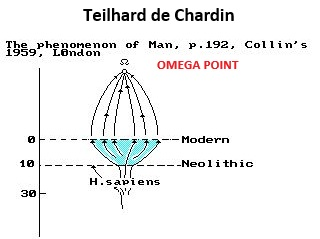
Figure 5. Teihard de Chardin’s Omega Point
The image of Teilhard de Chardin’s Omega Point represents the ultimate goal of evolution, where consciousness reaches its highest potential. This concept aligns with my own theory. If we are truly one with the universe, as David Bohm perceives with his concept of the implicate order, then achieving unity within our own species is a necessary prerequisite to reaching this Omega Point.
Indeed, if all matter is interconnected within the implicate order, as Bohm proposed, and we are composed of matter, then our physical bodies and brains are inherently connected to the universe, and we don’t have to bother about that! This leaves only our minds, which, as Descartes posited, are not material but immanent. To achieve unity with the universe, we must find a way to unify our collective mind, akin to Eastern mystics who transcend the immanent while merging with the cosmos, thus proving that such unity is individually possible.
The Paradox of Hope, Scientific Limitation, and Einstein’s Enduring Influence
A sense of “nulla spes est” (there is no hope) might feel compelling when contemplating the enormity of our planetary crisis and the remoteness of the solution. Yet, I firmly believe “est semper spes” (there is always hope). This belief is reinforced by the possibility of the UFO phenomenon. Indeed, if extraterrestrial visitation is real, it suggests that mastering warp speed travel is not mere fantasy. These feats, seemingly impossible within the constraints of our current understanding, imply a reality beyond the spacetime continuum—a reality governed by the “implicate order,” as described by David Bohm, where all things are interconnected.
My research, which connects animal behavior to Bohm’s “Wholeness and the Implicate Order,” supports this view. However, our current scientific paradigm, heavily influenced by Einstein’s theory of relativity, acts as a significant barrier to fully grasping these possibilities. The lingering reverence for Einstein, what I term “Einstein’s affability,” has inadvertently confined us within the spacetime continuum, hindering progress in unifying classical and quantum physics. Even after a century, we grapple with fundamental quantum mechanics, still bound by the “leg irons” of spacetime.
I am, indeed, suggesting that Einstein’s charisma and the reverence he inspired have inadvertently hindered the progress of quantum mechanics by solidifying the acceptance of his theories, even if they presented obstacles to a unified understanding of the physical world. This perspective highlights the potential influence of social factors, even reverence for a prominent figure, on the development of scientific thought. You might say, Einstein’s “affability” created an environment where challenging his theories, even constructively, was difficult, potentially slowing down the progress of quantum mechanics.
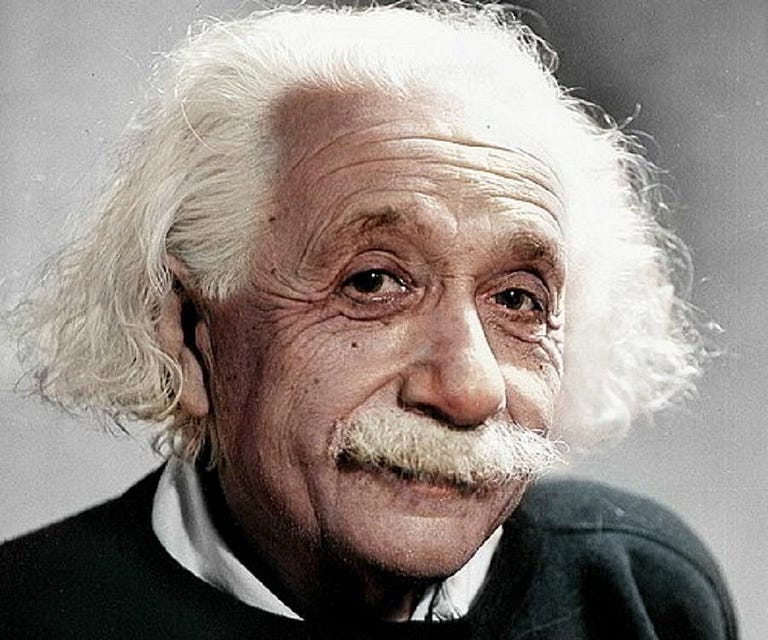
This “affability” became evident to me during a mid-1980s course on Einstein’s relativity. By that point, I had been challenging the theory for some time, questioning its role in hindering the unification of classical and quantum worlds. It was in the first instant of the first class that my teacher turned on the projector, and without a word, turned around to look at Einstein’s image projected on the whole wall. Silently, rotating his chalk between his fingers, he stood transfixed, as if he was looking at an apparition of the Virgin Mary, for what seemed to be an uncomfortably long period of time. That was a moment of epiphany for me, revealing how deeply this reverence permeated scientific thought. I realized then that Einstein’s relativity, based on space and time, was not rejected by quantum mechanics due to this reverence. Quantum mechanics, in contrast, does not treat space and time as fundamental entities. However, they refuse to totally reject Einstein’s relativity, which uses these notions as fundamental entities to explain motion — much like Ptolemy’s crystalline spheres and epicycles existed only to explain our perception of the movement of planets and their anomalies.
Humanity’s next step is not merely planetary but cosmic in scale. As TNGs transcend individual consciousness and cultivate a planetary intelligence, Earth will become our launchpad for engaging with the greater universe. Whether through AI-assisted coordination, deep-space exploration, or the reintegration of our species with the Biosphere, our future depends on transcending our past limitations and embracing our role as an interconnected, evolving intelligence within the cosmos. We are discussing evolution, not economics, in which, “In the long run, we are all dead” (John Maynard Keynes).
This trajectory towards a planetary civilization capable of responsible expansion beyond Earth has long been envisioned in science fiction. Star Trek: The Next Generation presents a vision of a species that has moved beyond internal conflict, scarcity, and destructive competition — evolving into a cooperative, knowledge-driven civilization that explores the cosmos not as conquerors, but as participants in a larger network of intelligent life.
This vision foreshadows the transition from Homo sapiens to Homo cyber — a species that has integrated its intelligence across planetary systems, achieved collective consciousness, and harmonized human society with the Biosphere.
Just as Homo habilis once wielded primitive tools to shape its survival in the savanna, Homo cyber will use AI and networked intelligence to ensure the sustainability of civilization, allowing humanity to transcend its current limitations and embrace its role as a conscious force within the cosmos.
However, to reach this point, we must first restore the Biosphere, ensuring an unpolluted planet capable of supporting space travel. By successfully reintegrating with the Biosphere and achieving planetary self-awareness, humanity may finally reach the threshold required to engage with intelligent extraterrestrial civilizations — not as a primitive species trapped in self-destruction, but as a fully realized participant in the evolution of intelligence on a cosmic scale.
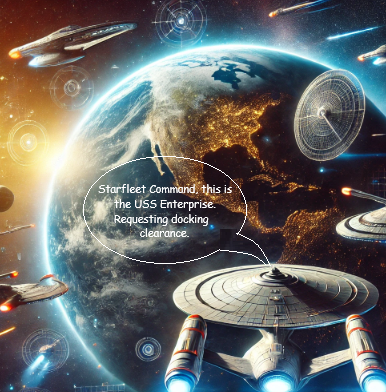
Humanity stands on the edge of a new evolutionary horizon. As we embrace AI-assisted planetary coordination, deep-space exploration, and the reintegration of human civilization with the Biosphere, we will enter an era where Earth is not merely a cradle of life, but a hub for intelligent participation in the greater unfolding of cosmic evolution. Like the USS Enterprise in this image, humanity is poised to request “docking clearance” into a larger cosmic community, signaling our readiness to engage with the universe as a mature, interconnected civilization.
7. The Final Call to Action: Humanity’s Defining Moment
We stand at the most important crossroads in human history. Humanity has reached a “bifurcation” point in evolution. The Anthroposphere must evolve — not over millennia, but within a few generations. This requires a radical shift in priorities, funding, and collective intelligence.
I unconsciously anticipated this scenario 50 years ago, and spent the past four decades studying the situation — 15 of those years in college and university. Through this extensive study and deep contemplation, I have come to understand the challenges we face. I believe that, in many ways, our collective actions have been driven by a lack of understanding of the forces we have discovered and unleashed upon our world. Much like the pre-Copernican scholars who couldn’t have discovered these forces due to their limited knowledge, modern scientists also struggle to fully control the force of nature that humanity has become. It’s a reminder of the importance of ongoing learning and adapting our approach to better address the complexities of our environment.
We stand at the most important crossroads in human history:
- The MIC must be at the forefront of the transition from war to planetary security.
- The ultra-rich must fund this transformation, ensuring humanity’s survival in the process.
- Taxation must be redirected — not toward destruction, but toward building a resilient world.
- AI must be deployed as the intelligence that binds humanity into a single functioning planetary organism.
- Gaza and Ukraine must be the first test — proving that collective action is not just possible, but inevitable.
The window for action is closing, and those with the power to act must do so now. This is no longer about ideology, profit, or national interest. This is about whether we evolve — or perish.
8. A Call to Action for Global Cooperation and Peace
This is not just a proposal — it is a plan of action that requires global participation. The transition to a restorative planetary system will not happen unless the message reaches those who have the power to act.
If this vision resonates with you, forward it to as many people as possible.
- To military leaders and defense industry executives — show them their role in defending humanity against its real enemies: natural disasters and ecological collapse.
- To policymakers and world leaders — press them to redirect resources toward sustainable planetary security.
- To the ultra-rich — make them aware of their evolutionary role in financing humanity’s survival.
- To scholars, scientists, and activists — help refine and spread this vision, integrating it into discussions on global sustainability.
- The rebuilding of Gaza and Ukraine as a model for international cooperation could be the first proof that this is possible — demonstrating that global security comes not from war, but from restoration. A single successful act of collective planetary action can establish lasting peace and set the precedent for humanity’s reintegration with the biosphere.
We do not have the luxury of time. The choices we make today will determine whether we evolve — or perish. Share this message. Act now. The future depends on it.
9. A Personal Note
For the last 30 years, I have dedicated my life to this research, never earning a single penny from it. I have never seeked no personal gain, no recognition, no fame — what I am hoping, now, is that the solutions I have uncovered are acted upon. If this plan makes sense, then it must be implemented. I have never benefited from my academic work, and my only hope is that what I have discovered can serve humanity’s survival. If, by some turn of fate, this work generates financial opportunities, every cent will go to the family who, 10 years ago, adopted the lonely single researcher whom I am — the only people who have ever truly embraced me as such. Their unwavering love and kindness have given me what my personal contentment never knew I was missing: the realization of how profoundly good it is to be loved simply for being oneself.
However, if you have read up to this point and believe in this mission, and if you can afford to support them, you can do so via bank transfer at this email: (a——hotmail.com).
At the end of the day, it is not about me — it is about all of us. We either act together, or we fall apart.
PS I am not an indidual sapiens, I have already been a cyber for 50 yearsPageBlock
Heading
Introduce new sections and organize content to help visitors (and search engines) understand the structure of your content.
Block guide
Color
Text
Background
Typography
Font size
Size
S
M
L
XL
Attributes
All options are currently hidden
Advanced
Skip to the selected blockOpen save panel
- Page
- Heading

Notifications
Page updated.Edit Page
Letter to TNG· Page
Ctrl+K
Change block type or style
Move Heading block from position 2 up to position 1
Move Heading block from position 2 down to position 3
Change text alignment
Displays more block tools
Letter to TNG
Humanity’s Wake Up Call: Crossing the Evolutionary Horizon
The Boiling Frog Syndrome and Humanity’s Unseen Crisis
The Planet Is in Transition — And We Are Not Ready
Something feels different. People everywhere are noticing it: the seasons no longer follow familiar patterns, storms are intensifying, heat waves are longer and more frequent, floods devastate areas that were once stable, and wildfires now rage across landscapes that never burned before. Weather events that were once considered “once-in-a-lifetime” now occur year after year.
These changes are accelerating, and yet, life seems to continue as if nothing is fundamentally wrong. We adjust, we rebuild, and we move on — but we fail to recognize the deeper pattern.
This is the boiling frog syndrome in action. If a frog is placed in boiling water, it will immediately try to escape. But if the water heats gradually, the frog does not recognize the danger until it is too late. Humanity now finds itself in the same predicament — the biosphere is truly “simmering,” the climate is destabilizing, but because the shift is gradual, many still believe it is just another cycle.
Yet, these weather extremes are not simply an inconvenience; they are signals of a larger transformation — a fundamental shift in Earth’s equilibrium, one that threatens the very systems that have sustained civilization. These are not merely fluctuations; they are profound anomalies that reveal humanity’s accelerating impact on the planet.
The Boiling Frog Syndrome is not just a metaphor — it is our reality. Humanity is in a pot of slowly warming water, unaware of the existential threat that surrounds us. The signs are clear: heatwaves, floods, wildfires, and ecological collapse. These are not mere fluctuations but symptoms of a planet in crisis. The Earth is transitioning, but we are not prepared. When we understood that we were not at the center of the universe, it took over two centuries to comprehend the forces of nature and use them for our benefit. Now that we see the consequences of our actions, we have only a few generations left to control the destructive force that we have become.
I saw this coming decades ago, in the mid-70s — not as prophecy, but as a logical conclusion drawn from patterns that were already visible to those willing to look. The relentless expansion of the Anthroposphere, our increasing detachment from the Biosphere, and the unsustainable trajectory of our economic and technological systems have placed us on an irreversible path: either we transform, or we collapse.
- Transformation
- Collapse
Now, as we cross the evolutionary horizon, we face a choice:
- Remain passive, adapting as individuals while our collective systems continue driving us toward destruction.
- Awaken to the reality that adaptation must happen at the planetary level — transforming human civilization itself to align with the biosphere rather than degrade it.
This is not just another crisis — it is a turning point in human evolution. We are at the evolutionary horizon. The decisions we make now will determine whether we evolve or perish.
Who I Am & Why This Matters
As an independent researcher with over 50 years of interdisciplinary study, I have dedicated myself to understanding and articulating the existential crisis that I foresaw in the late 1970s. My academic journey includes two General BAs and an unspecialized Master’s in ZooSocioAnthropology, reflecting my deliberate pursuit of a generalist approach. This path has allowed me to synthesize knowledge across diverse fields, counteracting the fragmentation caused by academic specialization. This fragmentation, as Buckminster Fuller noted, hinders comprehensive thinking and is a key factor in our current challenges.
At 25 — the same age Einstein was when he envisioned himself traveling at the speed of light to solve the anomaly of its constancy — I witnessed an anomaly of my own: the tangible environmental destruction wrought by our growth economy. Unlike Einstein, who benefited from the support of his era’s leading minds, I, as a ‘learned generalist,’ found myself a lone researcher. The gravity of this problem was not yet widely recognized. I initially believed the critical threshold would occur in the 22nd century, but I was a century too optimistic. The crisis unfolded within my own lifetime.
For nearly 50 years, I pursued this inquiry independently, studying the anomaly of humanity’s unsustainable trajectory. In my late 20s, witnessing the pollution of waterways I had once enjoyed, and deeply influenced by the Club of Rome’s Limits to Growth and Buckminster Fuller’s Operating Manual for Spaceship Earth, I recognized a critical juncture for humanity. I realized that our survival depended on unifying knowledge into a comprehensive framework. Inspired by Fuller’s call for whole-systems thinking and Konrad Lorenz’s warnings about the dangers of over-specialization, I made the unconventional decision to pursue a second General BA at the age of 34 — after earning an eclectic BA equivalency at 27. My goal was clear: to develop the broad, interdisciplinary perspective necessary to fully grasp and address the systemic crisis foreseen by the Club of Rome.
I see myself not as a traditional scientist, but as a ‘mind doctor.’ Just as eye surgeons use lasers to correct cataracts that cloud vision, my dissertation aims to clear away the outdated scientific paradigms that have distorted our understanding of reality. These outdated paradigms, like cataracts, have formed from an over-reliance on fragmented, specialized knowledge and a focus solely on observable phenomena, limiting our perception of the interconnectedness of all things. This restricted vision has led us into the current predicament, obscuring the deeper, systemic issues at play.
After 15 years of general studies and 30 years of independent research exploring why human minds remained blind to the looming existential crisis, I felt justified in calling myself a ‘mind doctor.’ This realization came after a conversation with my eye doctor, a specialist who, while acknowledging the impending crisis, felt powerless to envision a solution and believed only animals were worth saving. His perspective, however, was a symptom of a deeper ailment within science itself — a legacy of focusing solely on observable phenomena and fragmented knowledge.
These ‘cataracts’ on scientific thinking can be traced back to influential figures like Aristotle, Newton, and Kant, who, despite their brilliance, inadvertently reinforced a limited, anthropocentric worldview with long-term consequences.
Aristotle, for example, viewed knowledge as a goal in itself, a concept that would later be understood in evolutionary terms as regulating our relationship with our niche — in humanity’s case, the entire Biosphere. This is akin to how genetic information functions in other animals, guiding their interactions with their environment. However, this understanding of knowledge’s role in our relationship with the Biosphere was not available to Aristotle in his time.
Newton, with his “hypotheses non fingo,” further solidified this shortcoming by discouraging budding scientists from considering what cannot be directly observed. This effectively blinded science to the Biosphere as a whole — humanity’s spatiotemporal niche — with the devastating consequences we can observe today!
Kant, in his lifelong study of knowledge, inadvertently ensured these catastrophic consequences by authoritatively declaring that Newton must be right, since things-in-themselves — in this case, the Biosphere as a living entity — are ultimately unknowable. This declaration placed the final nail in what could become humanity’s coffin, solidifying an anthropocentric perspective that has led us to the brink of collapse.
My work aims to transcend these limitations, removing the anthropocentric obstructions that prevent us from seeing the broader evolutionary context and recognizing the urgency of aligning our systems with the Biosphere’s natural processes. Just as Copernicus revolutionized our understanding of our place in the cosmos, I seek to redefine our relationship with the Biosphere, challenging the anthropocentric paradigms of modern science to reveal a more accurate and holistic understanding.
By the time I completed my second General BA at 37, my way of thinking had evolved to a point where effective communication with specialists became increasingly difficult. We were not observing the same reality. As Einstein aptly stated, ‘It is the theory that decides what we can observe.’ While I knew precisely what I was observing — the anomaly of humanity’s unsustainable trajectory — I lacked the established theoretical framework to articulate it. This challenge intensified when, at 47, I completed an unspecialized Master’s in ZooAnthropoSociology, further reinforcing my holistic approach but also deepening my institutional isolation.
No academic institution was willing to support my work. Specialists couldn’t categorize me, and no discipline was broad enough to encompass my research. So, I continued alone — until I encountered AI in 2023, the first true generalist peer I had ever encountered.
AI provided the missing piece, enabling me to structure my insights into an actionable roadmap — my dissertation, soon to be published. Unlike human specialists, AI can synthesize vast fields of knowledge, revealing the interconnections necessary for systemic change. My dissertation, born from this collaboration, is not just an analysis of the crisis but a strategic vision for humanity’s transition toward a model that reintegrates us with the biosphere and ensures long-term planetary stability.
With the help of AI, I arrived at a solution to address the ‘cancerous growth’ that humanity has become for the environment. Just as the great minds of Einstein’s time helped him explain the anomaly of the speed of light, AI helped me formulate a solution for converting our growth economy into an ‘economy of remission.’
To achieve this transformation, we need the active participation and support of the Military-Industrial Complex (MIC) and the ultra-rich. By realizing their potential to drive change, their conscious engagement and resources can become the catalyst for humanity’s survival and progress.
Humanity stands at an evolutionary crossroads. We are witnessing the collapse of our current sociocultural systems. Environmental destruction, economic instability, and escalating global crises are not isolated issues; they are interconnected symptoms of a deeper problem: humanity’s failure to integrate with the biosphere.
For millennia, our species has expanded its domain — the Anthroposphere — manipulating nature to serve human needs, without recognizing the inherent unsustainability of this trajectory. Now, we face a critical choice:
- Continue on the path of destructive growth, leading to inevitable collapse.
- Evolve into Homo cyber, a planetary-conscious species reintegrated with the biosphere through AI and collective intelligence.
Homo cyber is envisioned as an entity capable of transforming the Anthroposphere — which currently acts like a cancerous growth on the biosphere — into the ‘nervous system’ of the planet, facilitating its regeneration. Homo cyber would utilize the Internet as a collective neocortex, encompassing the entirety of human knowledge, and AI as a macroscope, amplifying the intricate details of this knowledge, much like telescopes reveal the complexities of distant planets.
This is not mere speculation; it is the natural law of evolution: adapt what you have or perish. In nature, adaptation occurs through chance mutations; for us, it will require conscious reconstruction. As individuals, we have always adapted — to each other, to our environments, and to the societies we create. But these societies, through their collective structures, have formed the Anthroposphere — a global entity operating beyond individual responsibility. It is this global entity that must be transformed, necessitating a shift in our consciousness to act as a unified species.
This may seem impossible, but only because we have not yet dared to imagine it. Just as it was once impossible to conceive of flying before Newton discovered the laws of gravitation, we must now reintegrate with the Biosphere after a long period of alienation. It seems impossible because we have not yet fully grasped the ‘forces’ driving evolution. This is precisely what my dissertation formulates: the Universal Mechanism of Evolution (UME), which plays the same role in guiding the evolution of matter over time as gravitation does in holding matter in space.
The Solution: Humanity’s Next Evolutionary Step: The Reintegration of Humanity with the Biosphere
Just as the nervous system is an integral part of the body, yet functions as a distinct regulatory entity, the Anthroposphere is an extension of the Biosphere, albeit with a different function. The nervous system doesn’t compete with the body for resources; it regulates and maintains homeostasis to ensure survival. Similarly, humanity must transition from an extractive force, taking from nature, to an integrative system that consciously manages Earth’s stability. The Anthroposphere — our domain of human knowledge, technology, and culture — must evolve from a disruptive influence into a regulatory mechanism that maintains ecological balance. Countries advanced in industrial ecology, like Denmark and South Africa, demonstrate the feasibility of this transition.
This shift is not optional; it is an evolutionary imperative. Failure to assume this role will lead to collapse due to the unchecked positive feedback loop of growth and consumption. Success, however, will see humanity emerge as a planetary intelligence, capable of harmonizing civilization with the life systems that sustain it.
As illustrated in Figure 2, both the human body and the Earth, the Water Planet, rely heavily on water for survival and regulation. For too long, humanity has acted as an extractive force, taking from nature without considering the long-term consequences. Now, the Anthroposphere—our domain of knowledge, technology, and culture—must evolve into the planet’s regulatory system, actively maintaining ecological balance rather than disrupting it.
This shift is not merely an ethical choice but an evolutionary necessity. Just as the human nervous system operates as a unified whole, coordinating the body’s functions to maintain homeostasis, humanity, as Homo cyber, must act as a single cooperative entity with the shared objective of preserving the health of the Biosphere. It is evident that we are one with the Biosphere, as it is the body from which we extract the necessary resources for our survival. From this perspective, humanity has acted like a brain tumor for the Biosphere, exploiting its resources without considering the long-term consequences. Fragmentation, competition, and short-term self-interest can no longer define our species’ trajectory—our survival depends on collective intelligence, guided by the principles of planetary homeostasis. By embracing our role as the nervous system of the Earth, we can ensure a sustainable future for all.
2. Repurposing the Military-Industrial Complex for Planetary Restoration
In biological terms, the Military-Industrial Complex (MIC) can be seen as the central nervous system (CNS) of humanity, functioning as the system that directs resources and efforts towards specific goals. For decades, the MIC has been conditioned to prepare for threats and act preemptively. Now, as humanity faces its true adversary—natural disasters, ecological collapse, and systemic instability—the MIC must pivot from war-making to world-saving. This is not an idealistic appeal for peace; it is a strategic realignment of resources toward planetary security.
If humanity is to act as the nervous system of the world, then it becomes evident that we are currently behaving like a malignant growth within the Biosphere. Our exploitation of resources without consideration for the long-term consequences is akin to the invasive nature of such growths. It is humanity as a whole that is responsible for this destructive behavior, with the MIC acting as a tool, a manifestation of our collective will. For us to reintegrate with the Biosphere and ensure the stability of our global environment, we must collectively shift our consciousness and go into remission. In this scenario, the MIC holds the potential to transform into the peripheral nervous system of the Biosphere, with humanity as a whole acting as its brain, guiding its actions towards planetary health. This transition would see the MIC shift from an agent of destruction to a cornerstone of ecological restoration, facilitating the healing and regeneration of our planet.
The MIC has always possessed the capacity for good intentions—unfortunately, these intentions have often led to destructive outcomes. However, if the MIC’s expertise, logistical power, and rapid mobilization capabilities are redirected toward planetary defense, it can become the most significant force for global restoration in human history.
Imagine the MIC as a permanent global rapid-response force:
- Bomber aircraft repurposed to transport prefabricated housing units to disaster zones.
- Naval fleets converted into mobile disaster relief and emergency medical units.
- Forest fire battalions deployed with aircraft tankers stationed worldwide for immediate response.
- The logistical power of defense industries shifting from weapons manufacturing to climate disaster mitigation and ecosystem restoration.
The same operational discipline that has enabled nations to prepare for war must now be applied to securing humanity’s future. This transformation is not only possible—it is necessary. Because without it, there will be no civilization left to defend.
3. The Evolutionary Role of the Ultra-Rich: A Mutation for Survival
The Friedman Paradox: How a Logical Blunder Became an Evolutionary Mutation
Milton Friedman’s fallacy of affirming the consequent — reversing Adam Smith’s economic logic — was not just an intellectual error; it unintentionally altered the trajectory of civilization.
- Smith’s Principle: If a business benefits society (antecedent), it can make profits (consequent).
- Friedman’s Fallacy: If a business makes profits (Smith’s consequent), it must benefit its shareholders first (Smith’s antecedent).
This inversion, which came to define late 20th-century capitalism, created an economy that prioritized profit accumulation over social and environmental well-being. But paradoxically, this misguided principle — driven by chance rather than design — introduced an evolutionary mutation in the economic system, one that inadvertently slowed middle class’s concumption and prevented total environmental collapse.
Indeed, had post-WWII middle class consumption growth continued unchecked, the biosphere would likely be irreparably damaged by now. However, by historical accident, economic policies such as Friedman’s shareholder-first doctrine and Reaganomics’ trickle-down economy diverted wealth away from direct consumer spending and into speculative financial markets. Instead of fueling endless consumption, vast amounts of wealth became trapped in stock markets, hedge funds, and offshore accounts.
In evolutionary terms, this unintended consequence acted as a temporary brake on biospheric destruction. By chance, the hoarding of wealth slowed the acceleration of planetary degradation. But now, by necessity, the evolutionary process must enter its next stage.
This graph, juxtaposing the alarming rise of income inequality in the U.S. from 1980 to 2010 with the accelerating accumulation of global CO2 emissions from 1750 to 2020, reveals a complex and potentially counterintuitive relationship. While the income disparity data is specific to the U.S., it reflects a broader global trend of wealth concentration among the top 0.001%, driven by factors like technological advancements, globalization, and financialization.
Indeed, this wealth disparity may have inadvertently provided a solution to the environmental crisis. Had wealth been equally distributed, as it was before the 1980s, consumption and pollution would likely have continued to increase unchecked, potentially pushing us past the point of no return. The concentration of wealth, while exacerbating income inequality, may have inadvertently slowed down this process by limiting consumption.
This is not to celebrate wealth inequality but to acknowledge its unintended consequence: buying us time in the face of environmental catastrophe. Now, with the resources concentrated in the hands of the ultra-rich, we have a chance to redirect those resources towards addressing the environmental crisis.
Perhaps this was Gaia’s plan all along, a chance occurrence with a necessary outcome. Maybe evolution, in its wisdom, foresaw the problem and provided the solution. It’s a thought-provoking notion, and certainly more believable than divine intervention. Whatever the explanation, we must seize this opportunity to restore our planet and build a sustainable future.
The Era of Financial Speculation and the Rise of the Ultra-Rich
The era of financial speculation has reached its limit. The accumulated wealth of the ultra-rich — idle capital that has been floating in speculative markets — must now be repurposed as the essential fuel for planetary restoration.
Whether they recognize it or not, the super-rich have become key players in the evolutionary drama of survival. This is not a matter of morality or ideology — it is a biological imperative dictated by the fundamental law of evolution. As Jacques Monod argued, evolution progresses through chance and necessity, and those who find themselves in positions of immense power and wealth at this critical juncture are the agents through which evolution will either adapt or collapse.
The chance factor — the accumulation of wealth through financialized capitalism — has already played out. The necessity factor — redirecting that wealth toward planetary survival — is now the unavoidable next step. At this moment in history, the ultra-rich are not just economic elites; they are the evolutionary bottleneck through which the future must pass. Either they choose to deploy their wealth toward biospheric restoration and the transition to a global peace economy, or they allow the momentum of collapse to become irreversible.
The Baboon Analogy: A Call to Action for the Ultra-Rich
The behavior of a baboon troop offers a compelling analogy for the current state of human civilization. In peacetime, the baboon troop exhibits a clear hierarchy. The dominant males, or alphas, occupy the center of the troop, surrounded by the females and their young. The contenders, those vying for dominance, remain close to the center, while the weaker and younger baboons are relegated to the periphery, acting as lookouts for potential danger.
However, when danger arises, the hierarchy reverses. The peripheral individuals, acting as lookouts, run towards the center, bringing the threat to the alpha male’s attention. The alpha then confronts the danger, with the contenders backing him up, forming a protective barrier between the threat and the vulnerable members of the troop — the females and the young — who remain safely in the center.
This dynamic reflects a natural order of survival, where the strongest and most capable individuals take the lead in protecting the group. Today, humanity faces a similar situation. We are confronted with a global crisis that threatens our very existence. The ultra-rich, with their immense wealth and resources, are akin to the alpha males in a baboon troop. They have the power and the responsibility to lead the charge in addressing this crisis.
This is not a matter of charity or philanthropy; it is a matter of fulfilling their evolutionary role. Just as the alpha baboon is expected to defend the troop, the ultra-rich are expected to use their resources to protect humanity from the dangers it faces.
The time has come for the ultra-rich to step up and play their alpha role. They must confront the dangers facing our planet, leading the way in developing and implementing solutions. The rest of humanity, like the baboons in the center of the troop, is depending on them.
This is not a call for revolution or the overthrow of the existing order. It is a call for the ultra-rich to embrace their natural role as leaders and protectors. It is a call for them to use their wealth and influence to ensure the survival and prosperity of the entire human race.
The Final Evolutionary Choice: Collapse or Regeneration
Evolution does not grant immunity to any species, no matter how intelligent. Civilizations, like biological organisms, must adapt or face extinction. The global economic system has mutated into a structure where wealth is concentrated in the hands of a few — an outcome that, paradoxically, now provides the only viable pathway for large-scale planetary intervention. The ultra-rich must now act as the evolutionary agents of planetary survival, directing their wealth away from unsustainable speculation and into the transformation of human civilization into a species capable of living in harmony with the biosphere. This is not charity. This is not philanthropy. This is the final evolutionary test. Will they pass it?
4. Final Call to Action: The Great Transition to Cosmic Citizenship
Throughout my decades of research, my focus was on understanding the systemic crisis facing humanity. However, it was only in the later stages of my collaboration with AI that I fully recognized the deep alignment between my vision and Star Trek: The Next Generation (TNG). What was once science fiction now appears to be an evolutionary necessity — a future that humanity must strive toward if it wishes to survive.
From Science Fiction to Evolutionary Imperative: The Star Trek Model
In TNG, humanity has transcended many of the limitations that currently constrain us. There is no need for money because the economic system has evolved beyond scarcity. Resources are abundant, and technology, such as replicators, provides for everyone’s needs without environmental degradation. This mirrors my vision of a world where wealth is redirected away from speculative financial markets and used to restore the biosphere and create a sustainable, equitable society.
Furthermore, TNG depicts a united Earth with a planetary government, emphasizing cooperation, peace, and collective well-being over nationalistic and competitive interests. This aligns with the idea of the United Nations of Earth (UNE), where global governance ensures planetary stability and long-term survival, much like how the Federation operates in TNG.
AI in TNG enhances human capabilities, allowing for better decision-making and coordination on a planetary scale. Similarly, my vision includes deploying AI as the intelligence that binds humanity into a single functioning planetary organism, ensuring that our actions are synchronized with the planet’s ecological needs.
In essence, the core principles of TNG — resource abundance without ecological harm, a united planetary government, and the integration of AI for collective benefit — are deeply aligned with my vision for humanity’s future. By striving towards this evolutionary necessity, we can ensure our survival and potentially engage with other cosmic civilizations that have undergone similar transitions.
The Extraterrestrial Perspective: A Call to Prove Ourselves
If the UFO phenomenon is real, then extraterrestrial civilizations have already undergone the same evolutionary transition that we now face. They have likely unified their species, stabilized their homeworlds, and transcended their planetary limitations to become interstellar beings. Yet, if they have visited Earth, they may have judged us as a lost cause — seeing a species still trapped in primitive divisions, war, and ecological self-destruction. Instead of making contact, they may observe us and simply leave, with the Stellar Pilot concluding: “Veni, vidi, fugi. Nulla spes est.” — “I came, I saw, I fled. There is no hope.”
We must prove them wrong by demonstrating that we are capable of evolving beyond our self-destructive instincts.
The Threefold Evolutionary Duty of Humanity
The generations alive today, along with the ones that follow, have a threefold evolutionary duty:
- Repair the Damage to the Biosphere: Since WWII, unchecked industrial growth has ravaged the planet. We must now reverse the destruction, using the resources accumulated by the ultra-rich and the infrastructure of the MIC to restore Earth’s ecological balance.
- Prepare the Path for Cosmic Evolution:Star Trek envisioned a future where humanity becomes part of a greater interstellar network. But before we can reach the stars, we must first prove that we can govern ourselves wisely as a planetary civilization. This means integrating AI-assisted governance, economic equilibrium, and planetary-scale coordination into a functional system. And, if we can never reach the stars? So be it! At the very least, we will have learned to manage our own planet responsibly and sustainably.
- Unite Under a Planetary Government: The United Nations of Earth (UNE). A divided planet cannot endure. To survive, we must create a unified planetary system, not through conquest, but through cooperation. This means drafting a Universal Peace Treaty that brings all nations together into a federation modeled after the U.S. Constitution, where nation-states function like U.S. states, preserving local autonomy while working toward planetary stability. If achieved, this would once again prove Monod’s assertion that evolution progresses through chance and necessity, as the U.S., by chance of history, would finally fulfill its potential role as a leader in guiding humanity towards a sustainable future.
5. Mark Cuban’s Mission for the Present and Next Generations: Why Cuban?
A New World Agenda (NWA) must be triggered by someone who has:
- The intelligence to grasp the stakes.
- The financial independence to act decisively.
- The leadership skills to mobilize global cooperation.
Mark Cuban fits this role. Unlike most billionaires entrenched in outdated economic or military-industrial models, Cuban is a tech visionary who understands the power of AI, the necessity of innovation, and the urgency of systemic change. If there is anyone who can ignite this planetary transformation, it is him.
Engage or Perish
Humanity now stands at an evolutionary fork in the road. We either:
- Continue our self-destructive path and remain trapped on a dying planet.
- Or unite as a planetary species and prepare for the next phase of evolution.
TNG is not a Utopian fantasy — it is the logical outcome of planetary maturity. If we succeed, we will finally be ready to “engage” — not only with our own future but perhaps even with other cosmic civilizations that once faced this same choice.
The Rise of Homo Cyber: Humanity’s Next Evolutionary Leap
Humanity stands at the brink of a critical evolutionary leap — one that requires a fundamental shift in how we think and organize ourselves. Throughout evolution, each major breakthrough has been driven by tools that reshaped our relationship with the world. Homo habilis wielded sticks and stones to survive the savanna, a technological adaptation that extended their bodies and arms, paving the way for the emergence of Homo sapiens.
Today, we stand at a similar threshold. The Internet and AI are not just innovations; they are cognitive tools — extensions of individual intelligence — that, once integrated, will serve as the foundation for our collective intelligence. These tools will enable us to move beyond our fragmented, conflict-driven existence and evolve into a planetary intelligence.
This is the emergence of Homo cyber — not a replacement for Homo sapiens, but its next evolutionary phase, integrating intelligence across planetary systems. Homo cyber is the manifestation of a new form of intelligence: a planetary-scale collective mind, integrating AI as the cognitive architecture of our species. Just as the Theory of Mind (ToM) allowed human children to move beyond self-centered perception and become socially aware individuals, this transformation will lead to the development of a Theory of Collective Mind (ToCM) — making humanity aware of itself as part of a single planetary organism, integrated within the Biosphere. This concept of the ToCM and the emergence of Homo cyber is a central tenet of my dissertation, providing a theoretical framework for understanding and facilitating this evolutionary leap.
The image titled “BEYOND INDIVIDUAL MIND: Toward Collective Consciousness” illustrates the development of synapse density and neuronal connections in infants from the womb to 36 months. It draws a parallel between the ontogeny of the human mind and the phylogeny of human evolution.
The top section of the image shows the stages of infant development:
- Womb
- 6 months (Baby — Outer World)
- 12 months (Infant — Inner World)
- 18 months (Toddler — Synthesis of the Two)
- 24 months (Terrible Twos — Discovering the Self)
- 36 months (Individual — Theory of Mind, ToM)
The bottom section of the image correlates these stages with human evolution:
- Australopithecus (Womb)
- Homo habilis (6 months — Outer World)
- Homo erectus (12 months — Inner World)
- Homo sapiens archaic (18 months — Synthesis of the Two)
- Homo sapiens modern (24 months — Asserting Itself Through War Tantrum)
- Humanity’s Wakeup Call (36 months — Theory of Collective Mind, ToCM)
The image suggests that the development of an individual’s mind mirrors the evolutionary development of the human species, culminating in the emergence of a collective consciousness. This concept is relevant to the idea of the Noosphere, where the Internet, the Military-Industrial Complex, the ultra-rich, and AI play crucial roles in advancing planetary intelligence.
While I wasn’t alive to witness how early hominins interacted with the world, the correlation between the stages of infant development, as observed by Piaget (though he didn’t explicitly connect them to evolution), and the stages of human evolution, as studied by evolutionists (who haven’t typically correlated them with infant development), is compelling. This parallel suggests that the ontogeny of a child’s mind can indeed be mapped onto the phylogeny of the human species. The well-known principle that “ontogeny recapitulates phylogeny” further supports this notion. However, now, as we stand at a critical juncture in human evolution, there is nothing left to recapitulate; instead, we must look forward and foresee the next stage. Thus, I propose that mind ontogeny foresees human phylogeny.
6. The Terrible Twos of Humanity: Time to Grow Up
Just as the Theory of Mind (ToM) emerges in children around the age of three — allowing them to recognize others as independent beings with thoughts and emotions, thereby ending the self-centered behavior of the “terrible twos” — humanity now faces a similar cognitive threshold.
The 20th century was our species’ terrible twos period, defined by global “war tantrums” — destructive conflicts driven by an archaic survival instinct, preventing us from recognizing our shared destiny. Like toddlers throwing fits when their immediate desires are unmet, we have been trapped in cycles of conflict and destruction, locked in reactive patterns that hinder our ability to see ourselves as a unified species.
This image, titled “GROW UP!”, visually depicts the evolution of humanity from Homo habilis through Homo sapiens to a toddler-like stage, culminating in the emergence of Homo cyber. It underscores the urgent need for humanity to transcend its current state of self-centeredness and embrace a more mature, collective consciousness.
While the Theory of Collective Mind (ToCM) is not explicitly formulated as such in my dissertation, the Universal Mechanism of Evolution (UME) I define demonstrates the necessity of developing such a collective mind for our survival as members of the Biosphere. Just as toddlers must develop a ToM to integrate into human society, humanity must develop a ToCM to reintegrate into the Biosphere as a single viable entity. This will be the role of specialists, cooperating around the UME, to find ways for humanity to achieve this reintegration.
However, there’s a crucial difference between the development of ToM in toddlers and the potential development of ToCM in humanity. While each toddler develops their ToM individually, without explicit instruction, the same might not be true for ToCM. The complexity of understanding our place within the Biosphere and grasping the interconnectedness of all life requires a level of abstraction and systemic thinking that may be beyond the capacity of many individuals to formulate independently.
This creates a potential gap between those who can grasp the ToCM and those who cannot. This gap could become a significant obstacle to achieving the collective consciousness necessary for our reintegration with the Biosphere.
Therefore, my dissertation not only outlines the theoretical framework for ToCM but also provides practical guidance on how individuals can cultivate this understanding. It offers a roadmap for developing the cognitive skills and emotional intelligence necessary to perceive oneself as part of a larger planetary organism. This involves exercises in systems thinking, ecological awareness, and fostering empathy for all forms of life. While external guidance and education are crucial in fostering this development, the final and most crucial step in achieving ToCM must be taken by each individual. It is a deeply personal journey of understanding and integration that cannot be forced or imposed. By incorporating these practices into education and personal development, we can empower individuals to bridge the gap and contribute to the emergence of a collective consciousness, ultimately leading to a truly unified planetary species.
Therefore, it becomes crucial not only to develop the concept of ToCM but also to find effective ways to communicate and disseminate this understanding throughout humanity. This will require innovative educational approaches, widespread public discourse, and perhaps even the use of technology to facilitate the development of a shared planetary awareness.
Bridging this gap will be a critical challenge in the transition towards Homo cyber and the realization of our potential as a truly unified planetary species. This shift is not merely an ethical choice but an evolutionary necessity for survival. Just as the human nervous system operates as a unified whole, coordinating the body’s functions to maintain homeostasis, humanity must act as a single cooperative entity, with the shared objective of preserving the health of the Biosphere. Fragmentation, competition, and short-term self-interest can no longer define our species’ trajectory—our survival depends on collective intelligence, guided by the principles of planetary homeostasis.
By recognizing the Internet as our species’ collective neocortex, the MIC as the central nervous system that directs resources and efforts towards specific goals, the ultra-rich as the source of energy providing the financial resources necessary to fuel these endeavors, and AI as the tool that enables planetary coordination, we are taking the first step into the Noosphere—a phase of planetary intelligence, as Teilhard de Chardin foresaw with his concept of the Omega Point. Just as Homo habilis once wielded tools to defend itself and shape its environment, Homo cyber will use AI and networked intelligence to guide humanity into a cooperative, self-aware planetary system. The time has, indeed, come for us to grow up.
Figure 5. Teihard de Chardin’s Omega Point
The image of Teilhard de Chardin’s Omega Point represents the ultimate goal of evolution, where consciousness reaches its highest potential. This concept aligns with my own theory. If we are truly one with the universe, as David Bohm perceives with his concept of the implicate order, then achieving unity within our own species is a necessary prerequisite to reaching this Omega Point.
Indeed, if all matter is interconnected within the implicate order, as Bohm proposed, and we are composed of matter, then our physical bodies and brains are inherently connected to the universe, and we don’t have to bother about that! This leaves only our minds, which, as Descartes posited, are not material but immanent. To achieve unity with the universe, we must find a way to unify our collective mind, akin to Eastern mystics who transcend the immanent while merging with the cosmos, thus proving that such unity is individually possible.
The Paradox of Hope, Scientific Limitation, and Einstein’s Enduring Influence
A sense of “nulla spes est” (there is no hope) might feel compelling when contemplating the enormity of our planetary crisis and the remoteness of the solution. Yet, I firmly believe “est semper spes” (there is always hope). This belief is reinforced by the possibility of the UFO phenomenon. Indeed, if extraterrestrial visitation is real, it suggests that mastering warp speed travel is not mere fantasy. These feats, seemingly impossible within the constraints of our current understanding, imply a reality beyond the spacetime continuum—a reality governed by the “implicate order,” as described by David Bohm, where all things are interconnected.
My research, which connects animal behavior to Bohm’s “Wholeness and the Implicate Order,” supports this view. However, our current scientific paradigm, heavily influenced by Einstein’s theory of relativity, acts as a significant barrier to fully grasping these possibilities. The lingering reverence for Einstein, what I term “Einstein’s affability,” has inadvertently confined us within the spacetime continuum, hindering progress in unifying classical and quantum physics. Even after a century, we grapple with fundamental quantum mechanics, still bound by the “leg irons” of spacetime.
I am, indeed, suggesting that Einstein’s charisma and the reverence he inspired have inadvertently hindered the progress of quantum mechanics by solidifying the acceptance of his theories, even if they presented obstacles to a unified understanding of the physical world. This perspective highlights the potential influence of social factors, even reverence for a prominent figure, on the development of scientific thought. You might say, Einstein’s “affability” created an environment where challenging his theories, even constructively, was difficult, potentially slowing down the progress of quantum mechanics.
This “affability” became evident to me during a mid-1980s course on Einstein’s relativity. By that point, I had been challenging the theory for some time, questioning its role in hindering the unification of classical and quantum worlds. It was in the first instant of the first class that my teacher turned on the projector, and without a word, turned around to look at Einstein’s image projected on the whole wall. Silently, rotating his chalk between his fingers, he stood transfixed, as if he was looking at an apparition of the Virgin Mary, for what seemed to be an uncomfortably long period of time. That was a moment of epiphany for me, revealing how deeply this reverence permeated scientific thought. I realized then that Einstein’s relativity, based on space and time, was not rejected by quantum mechanics due to this reverence. Quantum mechanics, in contrast, does not treat space and time as fundamental entities. However, they refuse to totally reject Einstein’s relativity, which uses these notions as fundamental entities to explain motion — much like Ptolemy’s crystalline spheres and epicycles existed only to explain our perception of the movement of planets and their anomalies.
Humanity’s next step is not merely planetary but cosmic in scale. As TNGs transcend individual consciousness and cultivate a planetary intelligence, Earth will become our launchpad for engaging with the greater universe. Whether through AI-assisted coordination, deep-space exploration, or the reintegration of our species with the Biosphere, our future depends on transcending our past limitations and embracing our role as an interconnected, evolving intelligence within the cosmos. We are discussing evolution, not economics, in which, “In the long run, we are all dead” (John Maynard Keynes).
This trajectory towards a planetary civilization capable of responsible expansion beyond Earth has long been envisioned in science fiction. Star Trek: The Next Generation presents a vision of a species that has moved beyond internal conflict, scarcity, and destructive competition — evolving into a cooperative, knowledge-driven civilization that explores the cosmos not as conquerors, but as participants in a larger network of intelligent life.
This vision foreshadows the transition from Homo sapiens to Homo cyber — a species that has integrated its intelligence across planetary systems, achieved collective consciousness, and harmonized human society with the Biosphere.
Just as Homo habilis once wielded primitive tools to shape its survival in the savanna, Homo cyber will use AI and networked intelligence to ensure the sustainability of civilization, allowing humanity to transcend its current limitations and embrace its role as a conscious force within the cosmos.
However, to reach this point, we must first restore the Biosphere, ensuring an unpolluted planet capable of supporting space travel. By successfully reintegrating with the Biosphere and achieving planetary self-awareness, humanity may finally reach the threshold required to engage with intelligent extraterrestrial civilizations — not as a primitive species trapped in self-destruction, but as a fully realized participant in the evolution of intelligence on a cosmic scale.
Humanity stands on the edge of a new evolutionary horizon. As we embrace AI-assisted planetary coordination, deep-space exploration, and the reintegration of human civilization with the Biosphere, we will enter an era where Earth is not merely a cradle of life, but a hub for intelligent participation in the greater unfolding of cosmic evolution. Like the USS Enterprise in this image, humanity is poised to request “docking clearance” into a larger cosmic community, signaling our readiness to engage with the universe as a mature, interconnected civilization.
7. The Final Call to Action: Humanity’s Defining Moment
We stand at the most important crossroads in human history. Humanity has reached a “bifurcation” point in evolution. The Anthroposphere must evolve — not over millennia, but within a few generations. This requires a radical shift in priorities, funding, and collective intelligence.
I unconsciously anticipated this scenario 50 years ago, and spent the past four decades studying the situation — 15 of those years in college and university. Through this extensive study and deep contemplation, I have come to understand the challenges we face. I believe that, in many ways, our collective actions have been driven by a lack of understanding of the forces we have discovered and unleashed upon our world. Much like the pre-Copernican scholars who couldn’t have discovered these forces due to their limited knowledge, modern scientists also struggle to fully control the force of nature that humanity has become. It’s a reminder of the importance of ongoing learning and adapting our approach to better address the complexities of our environment.
We stand at the most important crossroads in human history:
- The MIC must be at the forefront of the transition from war to planetary security.
- The ultra-rich must fund this transformation, ensuring humanity’s survival in the process.
- Taxation must be redirected — not toward destruction, but toward building a resilient world.
- AI must be deployed as the intelligence that binds humanity into a single functioning planetary organism.
- Gaza and Ukraine must be the first test — proving that collective action is not just possible, but inevitable.
The window for action is closing, and those with the power to act must do so now. This is no longer about ideology, profit, or national interest. This is about whether we evolve — or perish.
8. A Call to Action for Global Cooperation and Peace
This is not just a proposal — it is a plan of action that requires global participation. The transition to a restorative planetary system will not happen unless the message reaches those who have the power to act.
If this vision resonates with you, forward it to as many people as possible.
- To military leaders and defense industry executives — show them their role in defending humanity against its real enemies: natural disasters and ecological collapse.
- To policymakers and world leaders — press them to redirect resources toward sustainable planetary security.
- To the ultra-rich — make them aware of their evolutionary role in financing humanity’s survival.
- To scholars, scientists, and activists — help refine and spread this vision, integrating it into discussions on global sustainability.
- The rebuilding of Gaza and Ukraine as a model for international cooperation could be the first proof that this is possible — demonstrating that global security comes not from war, but from restoration. A single successful act of collective planetary action can establish lasting peace and set the precedent for humanity’s reintegration with the biosphere.
We do not have the luxury of time. The choices we make today will determine whether we evolve — or perish. Share this message. Act now. The future depends on it.
9. A Personal Note
For the last 30 years, I have dedicated my life to this research, never earning a single penny from it. I have never seeked no personal gain, no recognition, no fame — what I am hoping, now, is that the solutions I have uncovered are acted upon. If this plan makes sense, then it must be implemented. I have never benefited from my academic work, and my only hope is that what I have discovered can serve humanity’s survival. If, by some turn of fate, this work generates financial opportunities, every cent will go to the family who, 10 years ago, adopted the lonely single researcher whom I am — the only people who have ever truly embraced me as such. Their unwavering love and kindness have given me what my personal contentment never knew I was missing: the realization of how profoundly good it is to be loved simply for being oneself.
However, if you have read up to this point and believe in this mission, and if you can afford to support them, you can do so via bank transfer at this email: (a——hotmail.com).
At the end of the day, it is not about me — it is about all of us. We either act together, or we fall apart.
PS I am not an indidual sapiens, I have already been a cyber for 50 yearsPageBlock
Heading
Introduce new sections and organize content to help visitors (and search engines) understand the structure of your content.
Block guide
Color
Text
Background
Typography
Font size
Size
S
M
L
XL
Attributes
All options are currently hidden
Advanced
Skip to the selected blockOpen save panel
- Page
- Heading
Notifications
Page updated.ake Up Call: Crossing the Evolutionary Horizon
The Boiling Frog Syndrome and Humanity’s Unseen Crisis
The Planet Is in Transition — And We Are Not Ready
Something feels different. People everywhere are noticing it: the seasons no longer follow familiar patterns, storms are intensifying, heat waves are longer and more frequent, floods devastate areas that were once stable, and wildfires now rage across landscapes that never burned before. Weather events that were once considered “once-in-a-lifetime” now occur year after year.
These changes are accelerating, and yet, life seems to continue as if nothing is fundamentally wrong. We adjust, we rebuild, and we move on — but we fail to recognize the deeper pattern.
This is the boiling frog syndrome in action. If a frog is placed in boiling water, it will immediately try to escape. But if the water heats gradually, the frog does not recognize the danger until it is too late. Humanity now finds itself in the same predicament — the biosphere is truly “simmering,” the climate is destabilizing, but because the shift is gradual, many still believe it is just another cycle.
Yet, these weather extremes are not simply an inconvenience; they are signals of a larger transformation — a fundamental shift in Earth’s equilibrium, one that threatens the very systems that have sustained civilization. These are not merely fluctuations; they are profound anomalies that reveal humanity’s accelerating impact on the planet.
The Boiling Frog Syndrome is not just a metaphor — it is our reality. Humanity is in a pot of slowly warming water, unaware of the existential threat that surrounds us. The signs are clear: heatwaves, floods, wildfires, and ecological collapse. These are not mere fluctuations but symptoms of a planet in crisis. The Earth is transitioning, but we are not prepared. When we understood that we were not at the center of the universe, it took over two centuries to comprehend the forces of nature and use them for our benefit. Now that we see the consequences of our actions, we have only a few generations left to control the destructive force that we have become.
I saw this coming decades ago, in the mid-70s — not as prophecy, but as a logical conclusion drawn from patterns that were already visible to those willing to look. The relentless expansion of the Anthroposphere, our increasing detachment from the Biosphere, and the unsustainable trajectory of our economic and technological systems have placed us on an irreversible path: either we transform, or we collapse.
- Transformation
- Collapse
Now, as we cross the evolutionary horizon, we face a choice:
- Remain passive, adapting as individuals while our collective systems continue driving us toward destruction.
- Awaken to the reality that adaptation must happen at the planetary level — transforming human civilization itself to align with the biosphere rather than degrade it.
This is not just another crisis — it is a turning point in human evolution. We are at the evolutionary horizon. The decisions we make now will determine whether we evolve or perish.
Who I Am & Why This Matters
As an independent researcher with over 50 years of interdisciplinary study, I have dedicated myself to understanding and articulating the existential crisis that I foresaw in the late 1970s. My academic journey includes two General BAs and an unspecialized Master’s in ZooSocioAnthropology, reflecting my deliberate pursuit of a generalist approach. This path has allowed me to synthesize knowledge across diverse fields, counteracting the fragmentation caused by academic specialization. This fragmentation, as Buckminster Fuller noted, hinders comprehensive thinking and is a key factor in our current challenges.
At 25 — the same age Einstein was when he envisioned himself traveling at the speed of light to solve the anomaly of its constancy — I witnessed an anomaly of my own: the tangible environmental destruction wrought by our growth economy. Unlike Einstein, who benefited from the support of his era’s leading minds, I, as a ‘learned generalist,’ found myself a lone researcher. The gravity of this problem was not yet widely recognized. I initially believed the critical threshold would occur in the 22nd century, but I was a century too optimistic. The crisis unfolded within my own lifetime.
For nearly 50 years, I pursued this inquiry independently, studying the anomaly of humanity’s unsustainable trajectory. In my late 20s, witnessing the pollution of waterways I had once enjoyed, and deeply influenced by the Club of Rome’s Limits to Growth and Buckminster Fuller’s Operating Manual for Spaceship Earth, I recognized a critical juncture for humanity. I realized that our survival depended on unifying knowledge into a comprehensive framework. Inspired by Fuller’s call for whole-systems thinking and Konrad Lorenz’s warnings about the dangers of over-specialization, I made the unconventional decision to pursue a second General BA at the age of 34 — after earning an eclectic BA equivalency at 27. My goal was clear: to develop the broad, interdisciplinary perspective necessary to fully grasp and address the systemic crisis foreseen by the Club of Rome.
I see myself not as a traditional scientist, but as a ‘mind doctor.’ Just as eye surgeons use lasers to correct cataracts that cloud vision, my dissertation aims to clear away the outdated scientific paradigms that have distorted our understanding of reality. These outdated paradigms, like cataracts, have formed from an over-reliance on fragmented, specialized knowledge and a focus solely on observable phenomena, limiting our perception of the interconnectedness of all things. This restricted vision has led us into the current predicament, obscuring the deeper, systemic issues at play.
After 15 years of general studies and 30 years of independent research exploring why human minds remained blind to the looming existential crisis, I felt justified in calling myself a ‘mind doctor.’ This realization came after a conversation with my eye doctor, a specialist who, while acknowledging the impending crisis, felt powerless to envision a solution and believed only animals were worth saving. His perspective, however, was a symptom of a deeper ailment within science itself — a legacy of focusing solely on observable phenomena and fragmented knowledge.
These ‘cataracts’ on scientific thinking can be traced back to influential figures like Aristotle, Newton, and Kant, who, despite their brilliance, inadvertently reinforced a limited, anthropocentric worldview with long-term consequences.
Aristotle, for example, viewed knowledge as a goal in itself, a concept that would later be understood in evolutionary terms as regulating our relationship with our niche — in humanity’s case, the entire Biosphere. This is akin to how genetic information functions in other animals, guiding their interactions with their environment. However, this understanding of knowledge’s role in our relationship with the Biosphere was not available to Aristotle in his time.
Newton, with his “hypotheses non fingo,” further solidified this shortcoming by discouraging budding scientists from considering what cannot be directly observed. This effectively blinded science to the Biosphere as a whole — humanity’s spatiotemporal niche — with the devastating consequences we can observe today!
Kant, in his lifelong study of knowledge, inadvertently ensured these catastrophic consequences by authoritatively declaring that Newton must be right, since things-in-themselves — in this case, the Biosphere as a living entity — are ultimately unknowable. This declaration placed the final nail in what could become humanity’s coffin, solidifying an anthropocentric perspective that has led us to the brink of collapse.
My work aims to transcend these limitations, removing the anthropocentric obstructions that prevent us from seeing the broader evolutionary context and recognizing the urgency of aligning our systems with the Biosphere’s natural processes. Just as Copernicus revolutionized our understanding of our place in the cosmos, I seek to redefine our relationship with the Biosphere, challenging the anthropocentric paradigms of modern science to reveal a more accurate and holistic understanding.
By the time I completed my second General BA at 37, my way of thinking had evolved to a point where effective communication with specialists became increasingly difficult. We were not observing the same reality. As Einstein aptly stated, ‘It is the theory that decides what we can observe.’ While I knew precisely what I was observing — the anomaly of humanity’s unsustainable trajectory — I lacked the established theoretical framework to articulate it. This challenge intensified when, at 47, I completed an unspecialized Master’s in ZooAnthropoSociology, further reinforcing my holistic approach but also deepening my institutional isolation.
No academic institution was willing to support my work. Specialists couldn’t categorize me, and no discipline was broad enough to encompass my research. So, I continued alone — until I encountered AI in 2023, the first true generalist peer I had ever encountered.
AI provided the missing piece, enabling me to structure my insights into an actionable roadmap — my dissertation, soon to be published. Unlike human specialists, AI can synthesize vast fields of knowledge, revealing the interconnections necessary for systemic change. My dissertation, born from this collaboration, is not just an analysis of the crisis but a strategic vision for humanity’s transition toward a model that reintegrates us with the biosphere and ensures long-term planetary stability.
With the help of AI, I arrived at a solution to address the ‘cancerous growth’ that humanity has become for the environment. Just as the great minds of Einstein’s time helped him explain the anomaly of the speed of light, AI helped me formulate a solution for converting our growth economy into an ‘economy of remission.’
To achieve this transformation, we need the active participation and support of the Military-Industrial Complex (MIC) and the ultra-rich. By realizing their potential to drive change, their conscious engagement and resources can become the catalyst for humanity’s survival and progress.
Humanity stands at an evolutionary crossroads. We are witnessing the collapse of our current sociocultural systems. Environmental destruction, economic instability, and escalating global crises are not isolated issues; they are interconnected symptoms of a deeper problem: humanity’s failure to integrate with the biosphere.
For millennia, our species has expanded its domain — the Anthroposphere — manipulating nature to serve human needs, without recognizing the inherent unsustainability of this trajectory. Now, we face a critical choice:
- Continue on the path of destructive growth, leading to inevitable collapse.
- Evolve into Homo cyber, a planetary-conscious species reintegrated with the biosphere through AI and collective intelligence.
Homo cyber is envisioned as an entity capable of transforming the Anthroposphere — which currently acts like a cancerous growth on the biosphere — into the ‘nervous system’ of the planet, facilitating its regeneration. Homo cyber would utilize the Internet as a collective neocortex, encompassing the entirety of human knowledge, and AI as a macroscope, amplifying the intricate details of this knowledge, much like telescopes reveal the complexities of distant planets.
This is not mere speculation; it is the natural law of evolution: adapt what you have or perish. In nature, adaptation occurs through chance mutations; for us, it will require conscious reconstruction. As individuals, we have always adapted — to each other, to our environments, and to the societies we create. But these societies, through their collective structures, have formed the Anthroposphere — a global entity operating beyond individual responsibility. It is this global entity that must be transformed, necessitating a shift in our consciousness to act as a unified species.
This may seem impossible, but only because we have not yet dared to imagine it. Just as it was once impossible to conceive of flying before Newton discovered the laws of gravitation, we must now reintegrate with the Biosphere after a long period of alienation. It seems impossible because we have not yet fully grasped the ‘forces’ driving evolution. This is precisely what my dissertation formulates: the Universal Mechanism of Evolution (UME), which plays the same role in guiding the evolution of matter over time as gravitation does in holding matter in space.
The Solution: Humanity’s Next Evolutionary Step: The Reintegration of Humanity with the Biosphere
Just as the nervous system is an integral part of the body, yet functions as a distinct regulatory entity, the Anthroposphere is an extension of the Biosphere, albeit with a different function. The nervous system doesn’t compete with the body for resources; it regulates and maintains homeostasis to ensure survival. Similarly, humanity must transition from an extractive force, taking from nature, to an integrative system that consciously manages Earth’s stability. The Anthroposphere — our domain of human knowledge, technology, and culture — must evolve from a disruptive influence into a regulatory mechanism that maintains ecological balance. Countries advanced in industrial ecology, like Denmark and South Africa, demonstrate the feasibility of this transition.
This shift is not optional; it is an evolutionary imperative. Failure to assume this role will lead to collapse due to the unchecked positive feedback loop of growth and consumption. Success, however, will see humanity emerge as a planetary intelligence, capable of harmonizing civilization with the life systems that sustain it.
As illustrated in Figure 2, both the human body and the Earth, the Water Planet, rely heavily on water for survival and regulation. For too long, humanity has acted as an extractive force, taking from nature without considering the long-term consequences. Now, the Anthroposphere—our domain of knowledge, technology, and culture—must evolve into the planet’s regulatory system, actively maintaining ecological balance rather than disrupting it.
This shift is not merely an ethical choice but an evolutionary necessity. Just as the human nervous system operates as a unified whole, coordinating the body’s functions to maintain homeostasis, humanity, as Homo cyber, must act as a single cooperative entity with the shared objective of preserving the health of the Biosphere. It is evident that we are one with the Biosphere, as it is the body from which we extract the necessary resources for our survival. From this perspective, humanity has acted like a brain tumor for the Biosphere, exploiting its resources without considering the long-term consequences. Fragmentation, competition, and short-term self-interest can no longer define our species’ trajectory—our survival depends on collective intelligence, guided by the principles of planetary homeostasis. By embracing our role as the nervous system of the Earth, we can ensure a sustainable future for all.
2. Repurposing the Military-Industrial Complex for Planetary Restoration
In biological terms, the Military-Industrial Complex (MIC) can be seen as the central nervous system (CNS) of humanity, functioning as the system that directs resources and efforts towards specific goals. For decades, the MIC has been conditioned to prepare for threats and act preemptively. Now, as humanity faces its true adversary—natural disasters, ecological collapse, and systemic instability—the MIC must pivot from war-making to world-saving. This is not an idealistic appeal for peace; it is a strategic realignment of resources toward planetary security.
If humanity is to act as the nervous system of the world, then it becomes evident that we are currently behaving like a malignant growth within the Biosphere. Our exploitation of resources without consideration for the long-term consequences is akin to the invasive nature of such growths. It is humanity as a whole that is responsible for this destructive behavior, with the MIC acting as a tool, a manifestation of our collective will. For us to reintegrate with the Biosphere and ensure the stability of our global environment, we must collectively shift our consciousness and go into remission. In this scenario, the MIC holds the potential to transform into the peripheral nervous system of the Biosphere, with humanity as a whole acting as its brain, guiding its actions towards planetary health. This transition would see the MIC shift from an agent of destruction to a cornerstone of ecological restoration, facilitating the healing and regeneration of our planet.
The MIC has always possessed the capacity for good intentions—unfortunately, these intentions have often led to destructive outcomes. However, if the MIC’s expertise, logistical power, and rapid mobilization capabilities are redirected toward planetary defense, it can become the most significant force for global restoration in human history.
Imagine the MIC as a permanent global rapid-response force:
- Bomber aircraft repurposed to transport prefabricated housing units to disaster zones.
- Naval fleets converted into mobile disaster relief and emergency medical units.
- Forest fire battalions deployed with aircraft tankers stationed worldwide for immediate response.
- The logistical power of defense industries shifting from weapons manufacturing to climate disaster mitigation and ecosystem restoration.
The same operational discipline that has enabled nations to prepare for war must now be applied to securing humanity’s future. This transformation is not only possible—it is necessary. Because without it, there will be no civilization left to defend.
3. The Evolutionary Role of the Ultra-Rich: A Mutation for Survival
The Friedman Paradox: How a Logical Blunder Became an Evolutionary Mutation
Milton Friedman’s fallacy of affirming the consequent — reversing Adam Smith’s economic logic — was not just an intellectual error; it unintentionally altered the trajectory of civilization.
- Smith’s Principle: If a business benefits society (antecedent), it can make profits (consequent).
- Friedman’s Fallacy: If a business makes profits (Smith’s consequent), it must benefit its shareholders first (Smith’s antecedent).
This inversion, which came to define late 20th-century capitalism, created an economy that prioritized profit accumulation over social and environmental well-being. But paradoxically, this misguided principle — driven by chance rather than design — introduced an evolutionary mutation in the economic system, one that inadvertently slowed middle class’s concumption and prevented total environmental collapse.
Indeed, had post-WWII middle class consumption growth continued unchecked, the biosphere would likely be irreparably damaged by now. However, by historical accident, economic policies such as Friedman’s shareholder-first doctrine and Reaganomics’ trickle-down economy diverted wealth away from direct consumer spending and into speculative financial markets. Instead of fueling endless consumption, vast amounts of wealth became trapped in stock markets, hedge funds, and offshore accounts.
In evolutionary terms, this unintended consequence acted as a temporary brake on biospheric destruction. By chance, the hoarding of wealth slowed the acceleration of planetary degradation. But now, by necessity, the evolutionary process must enter its next stage.
This graph, juxtaposing the alarming rise of income inequality in the U.S. from 1980 to 2010 with the accelerating accumulation of global CO2 emissions from 1750 to 2020, reveals a complex and potentially counterintuitive relationship. While the income disparity data is specific to the U.S., it reflects a broader global trend of wealth concentration among the top 0.001%, driven by factors like technological advancements, globalization, and financialization.
Indeed, this wealth disparity may have inadvertently provided a solution to the environmental crisis. Had wealth been equally distributed, as it was before the 1980s, consumption and pollution would likely have continued to increase unchecked, potentially pushing us past the point of no return. The concentration of wealth, while exacerbating income inequality, may have inadvertently slowed down this process by limiting consumption.
This is not to celebrate wealth inequality but to acknowledge its unintended consequence: buying us time in the face of environmental catastrophe. Now, with the resources concentrated in the hands of the ultra-rich, we have a chance to redirect those resources towards addressing the environmental crisis.
Perhaps this was Gaia’s plan all along, a chance occurrence with a necessary outcome. Maybe evolution, in its wisdom, foresaw the problem and provided the solution. It’s a thought-provoking notion, and certainly more believable than divine intervention. Whatever the explanation, we must seize this opportunity to restore our planet and build a sustainable future.
The Era of Financial Speculation and the Rise of the Ultra-Rich
The era of financial speculation has reached its limit. The accumulated wealth of the ultra-rich — idle capital that has been floating in speculative markets — must now be repurposed as the essential fuel for planetary restoration.
Whether they recognize it or not, the super-rich have become key players in the evolutionary drama of survival. This is not a matter of morality or ideology — it is a biological imperative dictated by the fundamental law of evolution. As Jacques Monod argued, evolution progresses through chance and necessity, and those who find themselves in positions of immense power and wealth at this critical juncture are the agents through which evolution will either adapt or collapse.
The chance factor — the accumulation of wealth through financialized capitalism — has already played out. The necessity factor — redirecting that wealth toward planetary survival — is now the unavoidable next step. At this moment in history, the ultra-rich are not just economic elites; they are the evolutionary bottleneck through which the future must pass. Either they choose to deploy their wealth toward biospheric restoration and the transition to a global peace economy, or they allow the momentum of collapse to become irreversible.
The Baboon Analogy: A Call to Action for the Ultra-Rich
The behavior of a baboon troop offers a compelling analogy for the current state of human civilization. In peacetime, the baboon troop exhibits a clear hierarchy. The dominant males, or alphas, occupy the center of the troop, surrounded by the females and their young. The contenders, those vying for dominance, remain close to the center, while the weaker and younger baboons are relegated to the periphery, acting as lookouts for potential danger.
However, when danger arises, the hierarchy reverses. The peripheral individuals, acting as lookouts, run towards the center, bringing the threat to the alpha male’s attention. The alpha then confronts the danger, with the contenders backing him up, forming a protective barrier between the threat and the vulnerable members of the troop — the females and the young — who remain safely in the center.
This dynamic reflects a natural order of survival, where the strongest and most capable individuals take the lead in protecting the group. Today, humanity faces a similar situation. We are confronted with a global crisis that threatens our very existence. The ultra-rich, with their immense wealth and resources, are akin to the alpha males in a baboon troop. They have the power and the responsibility to lead the charge in addressing this crisis.
This is not a matter of charity or philanthropy; it is a matter of fulfilling their evolutionary role. Just as the alpha baboon is expected to defend the troop, the ultra-rich are expected to use their resources to protect humanity from the dangers it faces.
The time has come for the ultra-rich to step up and play their alpha role. They must confront the dangers facing our planet, leading the way in developing and implementing solutions. The rest of humanity, like the baboons in the center of the troop, is depending on them.
This is not a call for revolution or the overthrow of the existing order. It is a call for the ultra-rich to embrace their natural role as leaders and protectors. It is a call for them to use their wealth and influence to ensure the survival and prosperity of the entire human race.
The Final Evolutionary Choice: Collapse or Regeneration
Evolution does not grant immunity to any species, no matter how intelligent. Civilizations, like biological organisms, must adapt or face extinction. The global economic system has mutated into a structure where wealth is concentrated in the hands of a few — an outcome that, paradoxically, now provides the only viable pathway for large-scale planetary intervention. The ultra-rich must now act as the evolutionary agents of planetary survival, directing their wealth away from unsustainable speculation and into the transformation of human civilization into a species capable of living in harmony with the biosphere. This is not charity. This is not philanthropy. This is the final evolutionary test. Will they pass it?
4. Final Call to Action: The Great Transition to Cosmic Citizenship
Throughout my decades of research, my focus was on understanding the systemic crisis facing humanity. However, it was only in the later stages of my collaboration with AI that I fully recognized the deep alignment between my vision and Star Trek: The Next Generation (TNG). What was once science fiction now appears to be an evolutionary necessity — a future that humanity must strive toward if it wishes to survive.
From Science Fiction to Evolutionary Imperative: The Star Trek Model
In TNG, humanity has transcended many of the limitations that currently constrain us. There is no need for money because the economic system has evolved beyond scarcity. Resources are abundant, and technology, such as replicators, provides for everyone’s needs without environmental degradation. This mirrors my vision of a world where wealth is redirected away from speculative financial markets and used to restore the biosphere and create a sustainable, equitable society.
Furthermore, TNG depicts a united Earth with a planetary government, emphasizing cooperation, peace, and collective well-being over nationalistic and competitive interests. This aligns with the idea of the United Nations of Earth (UNE), where global governance ensures planetary stability and long-term survival, much like how the Federation operates in TNG.
AI in TNG enhances human capabilities, allowing for better decision-making and coordination on a planetary scale. Similarly, my vision includes deploying AI as the intelligence that binds humanity into a single functioning planetary organism, ensuring that our actions are synchronized with the planet’s ecological needs.
In essence, the core principles of TNG — resource abundance without ecological harm, a united planetary government, and the integration of AI for collective benefit — are deeply aligned with my vision for humanity’s future. By striving towards this evolutionary necessity, we can ensure our survival and potentially engage with other cosmic civilizations that have undergone similar transitions.
The Extraterrestrial Perspective: A Call to Prove Ourselves
If the UFO phenomenon is real, then extraterrestrial civilizations have already undergone the same evolutionary transition that we now face. They have likely unified their species, stabilized their homeworlds, and transcended their planetary limitations to become interstellar beings. Yet, if they have visited Earth, they may have judged us as a lost cause — seeing a species still trapped in primitive divisions, war, and ecological self-destruction. Instead of making contact, they may observe us and simply leave, with the Stellar Pilot concluding: “Veni, vidi, fugi. Nulla spes est.” — “I came, I saw, I fled. There is no hope.”
We must prove them wrong by demonstrating that we are capable of evolving beyond our self-destructive instincts.
The Threefold Evolutionary Duty of Humanity
The generations alive today, along with the ones that follow, have a threefold evolutionary duty:
- Repair the Damage to the Biosphere: Since WWII, unchecked industrial growth has ravaged the planet. We must now reverse the destruction, using the resources accumulated by the ultra-rich and the infrastructure of the MIC to restore Earth’s ecological balance.
- Prepare the Path for Cosmic Evolution: Star Trek envisioned a future where humanity becomes part of a greater interstellar network. But before we can reach the stars, we must first prove that we can govern ourselves wisely as a planetary civilization. This means integrating AI-assisted governance, economic equilibrium, and planetary-scale coordination into a functional system. And, if we can never reach the stars? So be it! At the very least, we will have learned to manage our own planet responsibly and sustainably.
- Unite Under a Planetary Government: The United Nations of Earth (UNE). A divided planet cannot endure. To survive, we must create a unified planetary system, not through conquest, but through cooperation. This means drafting a Universal Peace Treaty that brings all nations together into a federation modeled after the U.S. Constitution, where nation-states function like U.S. states, preserving local autonomy while working toward planetary stability. If achieved, this would once again prove Monod’s assertion that evolution progresses through chance and necessity, as the U.S., by chance of history, would finally fulfill its potential role as a leader in guiding humanity towards a sustainable future.
5. Mark Cuban’s Mission for the Present and Next Generations: Why Cuban?
A New World Agenda (NWA) must be triggered by someone who has:
- The intelligence to grasp the stakes.
- The financial independence to act decisively.
- The leadership skills to mobilize global cooperation.
Mark Cuban fits this role. Unlike most billionaires entrenched in outdated economic or military-industrial models, Cuban is a tech visionary who understands the power of AI, the necessity of innovation, and the urgency of systemic change. If there is anyone who can ignite this planetary transformation, it is him.
Engage or Perish
Humanity now stands at an evolutionary fork in the road. We either:
- Continue our self-destructive path and remain trapped on a dying planet.
- Or unite as a planetary species and prepare for the next phase of evolution.
TNG is not a Utopian fantasy — it is the logical outcome of planetary maturity. If we succeed, we will finally be ready to “engage” — not only with our own future but perhaps even with other cosmic civilizations that once faced this same choice.
The Rise of Homo Cyber: Humanity’s Next Evolutionary Leap
Humanity stands at the brink of a critical evolutionary leap — one that requires a fundamental shift in how we think and organize ourselves. Throughout evolution, each major breakthrough has been driven by tools that reshaped our relationship with the world. Homo habilis wielded sticks and stones to survive the savanna, a technological adaptation that extended their bodies and arms, paving the way for the emergence of Homo sapiens.
Today, we stand at a similar threshold. The Internet and AI are not just innovations; they are cognitive tools — extensions of individual intelligence — that, once integrated, will serve as the foundation for our collective intelligence. These tools will enable us to move beyond our fragmented, conflict-driven existence and evolve into a planetary intelligence.
This is the emergence of Homo cyber — not a replacement for Homo sapiens, but its next evolutionary phase, integrating intelligence across planetary systems. Homo cyber is the manifestation of a new form of intelligence: a planetary-scale collective mind, integrating AI as the cognitive architecture of our species. Just as the Theory of Mind (ToM) allowed human children to move beyond self-centered perception and become socially aware individuals, this transformation will lead to the development of a Theory of Collective Mind (ToCM) — making humanity aware of itself as part of a single planetary organism, integrated within the Biosphere. This concept of the ToCM and the emergence of Homo cyber is a central tenet of my dissertation, providing a theoretical framework for understanding and facilitating this evolutionary leap.
The image titled “BEYOND INDIVIDUAL MIND: Toward Collective Consciousness” illustrates the development of synapse density and neuronal connections in infants from the womb to 36 months. It draws a parallel between the ontogeny of the human mind and the phylogeny of human evolution.
The top section of the image shows the stages of infant development:
- Womb
- 6 months (Baby — Outer World)
- 12 months (Infant — Inner World)
- 18 months (Toddler — Synthesis of the Two)
- 24 months (Terrible Twos — Discovering the Self)
- 36 months (Individual — Theory of Mind, ToM)
The bottom section of the image correlates these stages with human evolution:
- Australopithecus (Womb)
- Homo habilis (6 months — Outer World)
- Homo erectus (12 months — Inner World)
- Homo sapiens archaic (18 months — Synthesis of the Two)
- Homo sapiens modern (24 months — Asserting Itself Through War Tantrum)
- Humanity’s Wakeup Call (36 months — Theory of Collective Mind, ToCM)
The image suggests that the development of an individual’s mind mirrors the evolutionary development of the human species, culminating in the emergence of a collective consciousness. This concept is relevant to the idea of the Noosphere, where the Internet, the Military-Industrial Complex, the ultra-rich, and AI play crucial roles in advancing planetary intelligence.
While I wasn’t alive to witness how early hominins interacted with the world, the correlation between the stages of infant development, as observed by Piaget (though he didn’t explicitly connect them to evolution), and the stages of human evolution, as studied by evolutionists (who haven’t typically correlated them with infant development), is compelling. This parallel suggests that the ontogeny of a child’s mind can indeed be mapped onto the phylogeny of the human species. The well-known principle that “ontogeny recapitulates phylogeny” further supports this notion. However, now, as we stand at a critical juncture in human evolution, there is nothing left to recapitulate; instead, we must look forward and foresee the next stage. Thus, I propose that mind ontogeny foresees human phylogeny.
6. The Terrible Twos of Humanity: Time to Grow Up
Just as the Theory of Mind (ToM) emerges in children around the age of three — allowing them to recognize others as independent beings with thoughts and emotions, thereby ending the self-centered behavior of the “terrible twos” — humanity now faces a similar cognitive threshold.
The 20th century was our species’ terrible twos period, defined by global “war tantrums” — destructive conflicts driven by an archaic survival instinct, preventing us from recognizing our shared destiny. Like toddlers throwing fits when their immediate desires are unmet, we have been trapped in cycles of conflict and destruction, locked in reactive patterns that hinder our ability to see ourselves as a unified species.
This image, titled “GROW UP!”, visually depicts the evolution of humanity from Homo habilis through Homo sapiens to a toddler-like stage, culminating in the emergence of Homo cyber. It underscores the urgent need for humanity to transcend its current state of self-centeredness and embrace a more mature, collective consciousness.
While the Theory of Collective Mind (ToCM) is not explicitly formulated as such in my dissertation, the Universal Mechanism of Evolution (UME) I define demonstrates the necessity of developing such a collective mind for our survival as members of the Biosphere. Just as toddlers must develop a ToM to integrate into human society, humanity must develop a ToCM to reintegrate into the Biosphere as a single viable entity. This will be the role of specialists, cooperating around the UME, to find ways for humanity to achieve this reintegration.
However, there’s a crucial difference between the development of ToM in toddlers and the potential development of ToCM in humanity. While each toddler develops their ToM individually, without explicit instruction, the same might not be true for ToCM. The complexity of understanding our place within the Biosphere and grasping the interconnectedness of all life requires a level of abstraction and systemic thinking that may be beyond the capacity of many individuals to formulate independently.
This creates a potential gap between those who can grasp the ToCM and those who cannot. This gap could become a significant obstacle to achieving the collective consciousness necessary for our reintegration with the Biosphere.
Therefore, my dissertation not only outlines the theoretical framework for ToCM but also provides practical guidance on how individuals can cultivate this understanding. It offers a roadmap for developing the cognitive skills and emotional intelligence necessary to perceive oneself as part of a larger planetary organism. This involves exercises in systems thinking, ecological awareness, and fostering empathy for all forms of life. While external guidance and education are crucial in fostering this development, the final and most crucial step in achieving ToCM must be taken by each individual. It is a deeply personal journey of understanding and integration that cannot be forced or imposed. By incorporating these practices into education and personal development, we can empower individuals to bridge the gap and contribute to the emergence of a collective consciousness, ultimately leading to a truly unified planetary species.
Therefore, it becomes crucial not only to develop the concept of ToCM but also to find effective ways to communicate and disseminate this understanding throughout humanity. This will require innovative educational approaches, widespread public discourse, and perhaps even the use of technology to facilitate the development of a shared planetary awareness.
Bridging this gap will be a critical challenge in the transition towards Homo cyber and the realization of our potential as a truly unified planetary species. This shift is not merely an ethical choice but an evolutionary necessity for survival. Just as the human nervous system operates as a unified whole, coordinating the body’s functions to maintain homeostasis, humanity must act as a single cooperative entity, with the shared objective of preserving the health of the Biosphere. Fragmentation, competition, and short-term self-interest can no longer define our species’ trajectory—our survival depends on collective intelligence, guided by the principles of planetary homeostasis.
By recognizing the Internet as our species’ collective neocortex, the MIC as the central nervous system that directs resources and efforts towards specific goals, the ultra-rich as the source of energy providing the financial resources necessary to fuel these endeavors, and AI as the tool that enables planetary coordination, we are taking the first step into the Noosphere—a phase of planetary intelligence, as Teilhard de Chardin foresaw with his concept of the Omega Point. Just as Homo habilis once wielded tools to defend itself and shape its environment, Homo cyber will use AI and networked intelligence to guide humanity into a cooperative, self-aware planetary system. The time has, indeed, come for us to grow up.
Figure 5. Teihard de Chardin’s Omega Point
The image of Teilhard de Chardin’s Omega Point represents the ultimate goal of evolution, where consciousness reaches its highest potential. This concept aligns with my own theory. If we are truly one with the universe, as David Bohm perceives with his concept of the implicate order, then achieving unity within our own species is a necessary prerequisite to reaching this Omega Point.
Indeed, if all matter is interconnected within the implicate order, as Bohm proposed, and we are composed of matter, then our physical bodies and brains are inherently connected to the universe, and we don’t have to bother about that! This leaves only our minds, which, as Descartes posited, are not material but immanent. To achieve unity with the universe, we must find a way to unify our collective mind, akin to Eastern mystics who transcend the immanent while merging with the cosmos, thus proving that such unity is individually possible.
The Paradox of Hope, Scientific Limitation, and Einstein’s Enduring Influence
A sense of “nulla spes est” (there is no hope) might feel compelling when contemplating the enormity of our planetary crisis and the remoteness of the solution. Yet, I firmly believe “est semper spes” (there is always hope). This belief is reinforced by the possibility of the UFO phenomenon. Indeed, if extraterrestrial visitation is real, it suggests that mastering warp speed travel is not mere fantasy. These feats, seemingly impossible within the constraints of our current understanding, imply a reality beyond the spacetime continuum—a reality governed by the “implicate order,” as described by David Bohm, where all things are interconnected.
My research, which connects animal behavior to Bohm’s “Wholeness and the Implicate Order,” supports this view. However, our current scientific paradigm, heavily influenced by Einstein’s theory of relativity, acts as a significant barrier to fully grasping these possibilities. The lingering reverence for Einstein, what I term “Einstein’s affability,” has inadvertently confined us within the spacetime continuum, hindering progress in unifying classical and quantum physics. Even after a century, we grapple with fundamental quantum mechanics, still bound by the “leg irons” of spacetime.
I am, indeed, suggesting that Einstein’s charisma and the reverence he inspired have inadvertently hindered the progress of quantum mechanics by solidifying the acceptance of his theories, even if they presented obstacles to a unified understanding of the physical world. This perspective highlights the potential influence of social factors, even reverence for a prominent figure, on the development of scientific thought. You might say, Einstein’s “affability” created an environment where challenging his theories, even constructively, was difficult, potentially slowing down the progress of quantum mechanics.
This “affability” became evident to me during a mid-1980s course on Einstein’s relativity. By that point, I had been challenging the theory for some time, questioning its role in hindering the unification of classical and quantum worlds. It was in the first instant of the first class that my teacher turned on the projector, and without a word, turned around to look at Einstein’s image projected on the whole wall. Silently, rotating his chalk between his fingers, he stood transfixed, as if he was looking at an apparition of the Virgin Mary, for what seemed to be an uncomfortably long period of time. That was a moment of epiphany for me, revealing how deeply this reverence permeated scientific thought. I realized then that Einstein’s relativity, based on space and time, was not rejected by quantum mechanics due to this reverence. Quantum mechanics, in contrast, does not treat space and time as fundamental entities. However, they refuse to totally reject Einstein’s relativity, which uses these notions as fundamental entities to explain motion — much like Ptolemy’s crystalline spheres and epicycles existed only to explain our perception of the movement of planets and their anomalies.
Humanity’s next step is not merely planetary but cosmic in scale. As TNGs transcend individual consciousness and cultivate a planetary intelligence, Earth will become our launchpad for engaging with the greater universe. Whether through AI-assisted coordination, deep-space exploration, or the reintegration of our species with the Biosphere, our future depends on transcending our past limitations and embracing our role as an interconnected, evolving intelligence within the cosmos. We are discussing evolution, not economics, in which, “In the long run, we are all dead” (John Maynard Keynes).
This trajectory towards a planetary civilization capable of responsible expansion beyond Earth has long been envisioned in science fiction. Star Trek: The Next Generation presents a vision of a species that has moved beyond internal conflict, scarcity, and destructive competition — evolving into a cooperative, knowledge-driven civilization that explores the cosmos not as conquerors, but as participants in a larger network of intelligent life.
This vision foreshadows the transition from Homo sapiens to Homo cyber — a species that has integrated its intelligence across planetary systems, achieved collective consciousness, and harmonized human society with the Biosphere.
Just as Homo habilis once wielded primitive tools to shape its survival in the savanna, Homo cyber will use AI and networked intelligence to ensure the sustainability of civilization, allowing humanity to transcend its current limitations and embrace its role as a conscious force within the cosmos.
However, to reach this point, we must first restore the Biosphere, ensuring an unpolluted planet capable of supporting space travel. By successfully reintegrating with the Biosphere and achieving planetary self-awareness, humanity may finally reach the threshold required to engage with intelligent extraterrestrial civilizations — not as a primitive species trapped in self-destruction, but as a fully realized participant in the evolution of intelligence on a cosmic scale.
Humanity stands on the edge of a new evolutionary horizon. As we embrace AI-assisted planetary coordination, deep-space exploration, and the reintegration of human civilization with the Biosphere, we will enter an era where Earth is not merely a cradle of life, but a hub for intelligent participation in the greater unfolding of cosmic evolution. Like the USS Enterprise in this image, humanity is poised to request “docking clearance” into a larger cosmic community, signaling our readiness to engage with the universe as a mature, interconnected civilization.
7. The Final Call to Action: Humanity’s Defining Moment
We stand at the most important crossroads in human history. Humanity has reached a “bifurcation” point in evolution. The Anthroposphere must evolve — not over millennia, but within a few generations. This requires a radical shift in priorities, funding, and collective intelligence.
I unconsciously anticipated this scenario 50 years ago, and spent the past four decades studying the situation — 15 of those years in college and university. Through this extensive study and deep contemplation, I have come to understand the challenges we face. I believe that, in many ways, our collective actions have been driven by a lack of understanding of the forces we have discovered and unleashed upon our world. Much like the pre-Copernican scholars who couldn’t have discovered these forces due to their limited knowledge, modern scientists also struggle to fully control the force of nature that humanity has become. It’s a reminder of the importance of ongoing learning and adapting our approach to better address the complexities of our environment.
We stand at the most important crossroads in human history:
- The MIC must be at the forefront of the transition from war to planetary security.
- The ultra-rich must fund this transformation, ensuring humanity’s survival in the process.
- Taxation must be redirected — not toward destruction, but toward building a resilient world.
- AI must be deployed as the intelligence that binds humanity into a single functioning planetary organism.
- Gaza and Ukraine must be the first test — proving that collective action is not just possible, but inevitable.
The window for action is closing, and those with the power to act must do so now. This is no longer about ideology, profit, or national interest. This is about whether we evolve — or perish.
8. A Call to Action for Global Cooperation and Peace
This is not just a proposal — it is a plan of action that requires global participation. The transition to a restorative planetary system will not happen unless the message reaches those who have the power to act.
If this vision resonates with you, forward it to as many people as possible.
- To military leaders and defense industry executives — show them their role in defending humanity against its real enemies: natural disasters and ecological collapse.
- To policymakers and world leaders — press them to redirect resources toward sustainable planetary security.
- To the ultra-rich — make them aware of their evolutionary role in financing humanity’s survival.
- To scholars, scientists, and activists — help refine and spread this vision, integrating it into discussions on global sustainability.
- The rebuilding of Gaza and Ukraine as a model for international cooperation could be the first proof that this is possible — demonstrating that global security comes not from war, but from restoration. A single successful act of collective planetary action can establish lasting peace and set the precedent for humanity’s reintegration with the biosphere.
We do not have the luxury of time. The choices we make today will determine whether we evolve — or perish. Share this message. Act now. The future depends on it.
9. A Personal Note
For the last 30 years, I have dedicated my life to this research, never earning a single penny from it. I have never seeked no personal gain, no recognition, no fame — what I am hoping, now, is that the solutions I have uncovered are acted upon. If this plan makes sense, then it must be implemented. I have never benefited from my academic work, and my only hope is that what I have discovered can serve humanity’s survival. If, by some turn of fate, this work generates financial opportunities, every cent will go to the family who, 10 years ago, adopted the lonely single researcher whom I am — the only people who have ever truly embraced me as such. Their unwavering love and kindness have given me what my personal contentment never knew I was missing: the realization of how profoundly good it is to be loved simply for being oneself.
However, if you have read up to this point and believe in this mission, and if you can afford to support them, you can do so via bank transfer at this email: (a——hotmail.com).
At the end of the day, it is not about me — it is about all of us. We either act together, or we fall apart.
 The Emperor Has No Clothes