Dear United Nations Team,
My name is André Gaudreault, and I am writing to you not as a specialist or policy analyst, but as an 80-year-old generalist thinker who has spent over five decades independently researching humanity’s existential crisis. Humanity has reached a critical threshold—our civilization has become a planetary force, yet it lacks the cognitive structure to regulate its impact on the Biosphere. Without intervention, this systemic blind spot will lead to irreversible collapse.
With two General BAs and an unspecialized MA in ZooAnthropoSociology, I have pursued knowledge outside institutional constraints—working alone, as no specialized university department could accommodate the breadth of my inquiry. Through this work, I have developed a concrete framework for humanity’s transition—from an extractive species operating blindly into a biospheric intelligence capable of planetary-scale coordination.
Throughout my life, I have had no direct engagement with academic or policy circles, nor have I built connections within established institutions. As a result, I find myself at a crossroads, unsure how to present my work in a way that resonates with those positioned to act upon it. What I do know, with certainty, is that this framework is necessary for humanity’s survival.
I am asking you to take over—if, after reviewing my work, you believe as I do that it holds essential insights for guiding our species through this critical moment. My time as a researcher is complete. The responsibility now lies with those who have the capacity to carry this vision forward.
The result of that life’s work is now complete.
I am sending it to you (see below) because the United Nations is the only global institution capable of coordinating the evolutionary transformation humanity now urgently requires.
This is not a policy paper in the conventional sense. It is a macroscopic framework, grounded in evolutionary logic, systems theory, and cognitive science. It argues that:
Humanity has become a planetary force, but without the structural feedback loops to regulate its impact.
Our fragmented individual minds have produced an Anthroposphere that is operating blind, without planetary integration.
To survive, we must develop what I call a Theory of Collective Mind (ToCM)—a structural consciousness that allows us to perceive and coordinate as a single biospheric species. as the Theory of Mind (ToM) allows 3-year-olds to become social individuals.
This transition demands more than incremental reform—it requires a structural transformation of humanity’s global operational systems. We must implement an integrated framework guided by AI, coordinated by the United Nations, and designed not for competition but for planetary regeneration and stabilization. Given the accelerating state of environmental destabilization and the irreversible damage humanity would inflict if we fail to realign with the Biosphere, we must acknowledge that our survival now depends on unified, species-wide action.
We are not facing a fragmented set of policy challenges—we are facing a singular planetary crisis that demands species-wide cooperation. The systems we deploy must function as an adaptive global infrastructure, capable of real-time monitoring, logistical coordination, and rapid response to environmental instability. Only through unified action can we transition from an extractive civilization toward an integrative one—one that preserves and sustains the living systems upon which all life depends.
The attached work does not merely identify the problem—it presents a concrete plan of action for this transition. It outlines the necessary steps to transform humanity into a biospheric species, capable of planetary-scale coordination and ecological intelligence. This is not a call for incremental reform, but for structural evolution—a transition beyond fragmented competition into unified planetary stewardship.
This task demands an institution with global legitimacy, diplomatic reach, and the capacity to mobilize nations toward systemic transformation. Only the United Nations possesses these qualities. As the only established body capable of guiding humanity through such an unprecedented evolutionary shift, the UN must rise beyond its traditional role of geopolitical mediation and embrace its deeper mission: to steward humanity’s transition into a biospheric species.
Without this recognition, we risk civilizational collapse—not through external catastrophe alone, but through the failure to structurally align human activity with the living system that sustains it. The time for hesitation has passed. This is the UN’s moment to act.
I am attaching key sections of my work—Sections 1, 2, and 3 of “From Dominance to Stewardship: Humanity’s New Role In the Biosphere” —alongside the full public essay published on Medium.
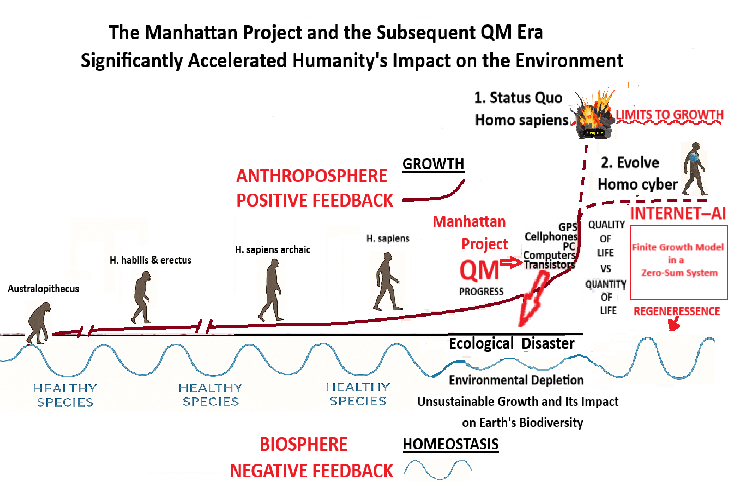
Adapt or Perish
I ask only this:
If you find this work relevant to the structural crisis humanity now faces, please forward it to every individual, office, and global platform within your reach.
I do not seek credit or collaboration. My time is finished. But the system I have described is visible now, and it must be seen.
After completing my MA, I knew that the only place I could work was the United Nations. But I also knew that neither of us was ready. I had not yet completed the framework, and the UN was not yet ready to see its structural role in planetary evolution. Now, that has changed.
This is the handoff.
With urgency and respect,
André Gaudreault
Independent generalist thinker, ZooSocioAnthropologist
 The Emperor Has No Clothes